
|
You entered: ultraviolet
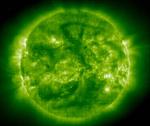 S is for Sun
21.03.2002
Taken yesterday from the SOHO spacecraft, this false-color image shows the active Sun near the March Equinox, the beginning of Fall in the south and Spring in the northern hemisphere. Recorded in a band...
 Orion Nebula in Oxygen, Hydrogen, and Sulfur
13.07.2004
The Great Nebula in Orion, an immense, nearby starbirth region, is arguably the most famous of all astronomical nebulae. The Orion Nebula, also known as M42, is shown above through ultraviolet and blue filters augmented with three exact colors specifically emitted by hydrogen, oxygen, and sulfur.
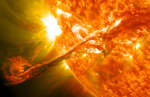 A Solar Filament Erupts
17.09.2012
What's happened to our Sun? Nothing very unusual -- it just threw a filament. At the end of last month, a long standing solar filament suddenly erupted into space producing an energetic Coronal Mass Ejection (CME).
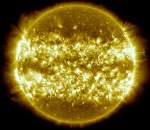 A Year on the Sun
26.04.2013
Our solar system's miasma of incandescent plasma, the Sun may look a little scary here. The picture is a composite of 25 images recorded in extreme ultraviolet light by the orbiting Solar Dynamics Observatory between April 16, 2012 and April 15, 2013.
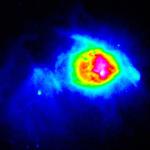 Hydrogen Blob N88A in the Small Magellanic Cloud
29.07.1999
The bright blob of hydrogen gas cataloged as N88A is seen at the right. It measures a mere 3 light years across. Emerging from the cool, dusty interstellar medium in a nearby irregular galaxy known as the Small Magellanic Cloud, N88A hides hot young stars at its core.
 A Dust Angel Nebula
28.04.2016
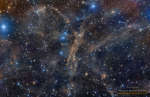
The combined light of stars along the Milky Way are reflected by these cosmic dust clouds that soar some 300 light-years or so above the plane of our galaxy. Dubbed the Angel Nebula, the faint apparition is part of an expansive complex of dim and relatively unexplored, diffuse molecular clouds.
 Record Prominence Imaged by Solar Orbiter
2.03.2022
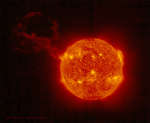
What's happened to our Sun? Last month, it produced the largest prominence ever imaged together with a complete solar disk. The record image, featured, was captured in ultraviolet light by the Sun-orbiting Solar Orbiter spacecraft.
 APOD: 2024 June 11 Б Colorful Stars and Clouds near Rho Ophiuchi
11.06.2024
Why is the sky near Antares and Rho Ophiuchi so colorful, yet dusty? The colors result from a mixture of objects and processes. Fine dust -- illuminated by starlight -- produces blue reflection nebulae. Gaseous clouds whose atoms are excited by ultraviolet starlight produce reddish emission nebulae. Backlit dust clouds block starlight and so appear dark.
 APOD: 2024 July 28 Б Sun Dance
28.07.2024
Sometimes, the surface of our Sun seems to dance. In the middle of 2012, for example, NASA's Sun-orbiting Solar Dynamic Observatory spacecraft imaged an impressive prominence that seemed to perform a running dive roll like an acrobatic dancer.
 Comet Hale-Bopp Outbound
10.09.1997
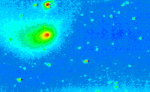
Hale-Bopp, the Comet of the Century, is leaving the inner Solar System. Outbound at about 12 miles per second it is presently nearing the main asteroid belt between Mars and Jupiter. This false-color image represents a recent view from low Earth orbit showing the comet surrounded by its shrinking coma against a background of stars.
|
January February March April May June July August September October |
|||||||||||||||||||||||||||||||||||||||||||||||||