
|
You entered: ultraviolet
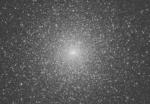 Globular Cluster M15
10.12.2001
Stars, like bees, swarm around the center of bright globular cluster M15. This ball of over 100,000 stars is a relic from the early years of our Galaxy, and continues to orbit the Milky Way's center.
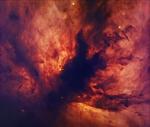 Flame Nebula Close Up
2.02.2007
Of course, the Flame Nebula is not on fire. Also known as NGC 2024, the nebula's suggestive reddish color is due to the glow of hydrogen atoms at the edge of the giant Orion molecular cloud complex some 1,500 light-years away.
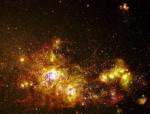 NGC 4214: Star Forming Galaxy
7.01.2000
Dazzling displays of star formation abound across the face of galaxy NGC 4214, a mere 13 million light-years away in the northern constellation Canes Venatici. While this 1997 Hubble Space Telescope image shows...
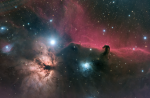 Horsehead and Flame
29.12.2022
The Horsehead Nebula, famous celestial dark marking also known as Barnard 33, is notched against a background glow of emission nebulae in this sharp cosmic skyscape. About five light-years "tall" the Horsehead lies some 1,500 light-years away in the constellation of Orion.
 Galactic Cirrus: Mandel Wilson 9
21.07.2023
The combined light of stars along the Milky Way are reflected by these cosmic dust clouds that soar 300 light-years or so above the plane of our galaxy. Known to some as integrated flux nebulae and commonly found at high galactic latitudes, the dusty galactic cirrus clouds are faint.
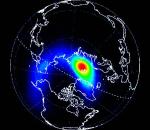 X-Ray Earth
16.09.2000
Above is a picture of the Earth in x-rays, taken in March of 1996 from the orbiting Polar satellite. Most of the planet is dark with superposed continent and coordinate grids, while the bright x-ray emission near the north pole is shown in red. Why does the Earth have an x-ray glow?
 Cassini Images Saturns A Ring
12.07.2004
What are Saturn's rings made of? In an effort to find out, the robot spacecraft Cassini that entered orbit around Saturn two weeks ago took several detailed images of the area surrounding Saturn's large A ring in ultraviolet light.
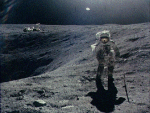 Apollo 16: Exploring Plum Crater
20.12.1997
Apollo 16 spent three days on Earth's Moon in April 1972. The fifth lunar landing mission out of six, Apollo 16 was famous for deploying and using an ultraviolet telescope as the first lunar observatory, and for collecting rocks and data on the mysterious lunar highlands. In the above picture, astronaut John W.
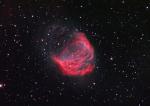 The Medusa Nebula
23.11.2007
Braided, serpentine filaments of glowing gas suggest this nebula's popular name, The Medusa Nebula. Also known as Abell 21, this Medusa is an old planetary nebula some 1,500 light-years away in the constellation Gemini. Like its mythological namesake, the nebula is associated with a dramatic transformation.
 The Medusa Nebula
25.10.2012
Braided, serpentine filaments of glowing gas suggest this nebula's popular name, The Medusa Nebula. Also known as Abell 21, this Medusa is an old planetary nebula some 1,500 light-years away in the constellation Gemini. Like its mythological namesake, the nebula is associated with a dramatic transformation.
|
January February March April May June July August September October |
|||||||||||||||||||||||||||||||||||||||||||||||||