
|
You entered: ultraviolet
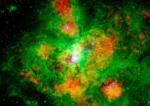 30 Doradus Across the Spectrum
24.12.1997
30 Doradus is lit up like a Christmas tree. Shining in light across the electromagnetic spectrum, 30 Doradus glows because of all the energetic processes that go on there. A distinctive region visible...
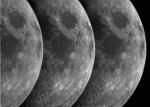 Cassini Images The Moon
10.09.1999
On August 18, the Cassini spacecraft flew by the Earth and Moon, then continued on its way to the outer solar system. Near its closest approach to the Moon, a distance of about 377,000 kilometers, controllers tested Cassini's imaging systems on this most familiar celestial body.
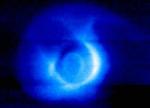 Earth's Plasmasphere
31.01.2001
Our Earth is surrounded by plasma. The overall shape that this ionized gas plasmasphere takes was discovered last year by NASA's robot IMAGE spacecraft, and shown in the recently released above image in ultraviolet light.
 APOD: 2024 April 24 Б Dragons Egg Bipolar Emission Nebula
24.04.2024
How did a star form this beautiful nebula? In the middle of emission nebula NGC 6164 is an unusually massive star. The central star has been compared to an oyster's pearl and an egg protected by the mythical sky dragons of Ara.
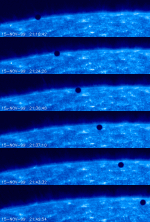 Mercury And The Sun
19.11.1999
Just days before the peak of the Leonid meteor shower, skywatchers were offered another astronomical treat as planet Mercury crossed the face of the Sun on November 15. Viewed from planet Earth, a transit of Mercury is not all that rare. The last occurred in 1993 and the next will happen in 2003.
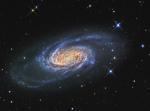 Bright Galaxy NGC 2903
6.07.2007
Spiral galaxy NGC 2903 is only some 20 million light-years distant in the constellation Leo. One of the brighter galaxies visible from the northern hemisphere, it is surprisingly missing from Charles Messier's famous catalog of celestial sights. This impressively sharp color image shows off the galaxy's beautiful blue spiral arms.
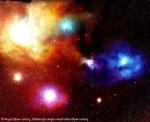 Antares and Rho Ophiuchi
21.05.2000
Why is the sky near Antares and Rho Ophiuchi so colorful? The colors result from a mixture of objects and processes. Fine dust illuminated from the front by starlight produces blue reflection nebulae. Gaseous clouds whose atoms are excited by ultraviolet starlight produce reddish emission nebulae. Backlit dust clouds block starlight and so appear dark.
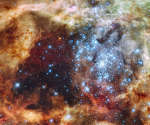 Star Cluster R136 Bursts Out
29.07.2012
In the center of star-forming region 30 Doradus lies a huge cluster of the largest, hottest, most massive stars known. These stars, known collectively as star cluster R136, were captured above in visible light by the newly installed Wide Field Camera peering though the recently refurbished Hubble Space Telescope.
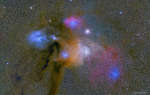 Colorful Clouds Near Rho Ophiuchi
6.07.2015
Why is the sky near Antares and Rho Ophiuchi so colorful? The colors result from a mixture of objects and processes. Fine dust illuminated from the front by starlight produces blue reflection nebulae. Gaseous clouds whose atoms are excited by ultraviolet starlight produce reddish emission nebulae. Backlit dust clouds block starlight and so appear dark.
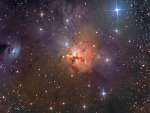 NGC 1579: Trifid of the North
30.01.2009
Colorful NGC 1579 resembles the better known Trifid Nebula, but lies much farther north in planet Earth's sky, in the heroic constellation Perseus. About 2,100 light-years away and 3 light-years across...
|
January February March April May June July August September October |
|||||||||||||||||||||||||||||||||||||||||||||||||