
|
You entered: ultraviolet
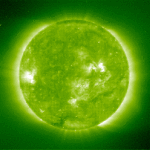 Sun and Winter Solstice 1996
21.12.1996
Today is the Winter Solstice for 1996. After steadily sinking in Northern Hemisphere skies, the Sun is now at its lowest declination - marking the first day of Northern Winter (but Southern Summer!). The Earth...
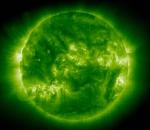 The Iron Sun
25.09.2004
The ultraviolet light emitted by eleven times ionized iron at temperatures over 2 million degrees Farenheit was used to record the above picture of the Sun on September 22, 2001, the date of that year's autumnal equinox.
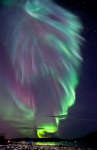 Aurora Over Norway
20.09.2010
Auroras can make spectacular sights. Photographed above last weekend, flowing multi-colored auroras helped illuminate a busy sky above TromsЬ, Norway. Besides the spectacular aurora pictured above, the photographer caught three satellites streaks, one airplane streak, and a friend trying to capture the same sight.
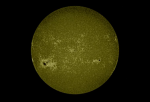 Sunspot Group AR 2192 Crackles
22.10.2014
One of the largest sunspot groups in recent years is now crossing the Sun. Labelled Active Region 2192, it has already thrown a powerful solar flare and has the potential to produce more.
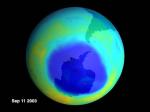 A Near Record Ozone Hole in 2003
6.10.2003
As expected, the ozone hole near Earth's South Pole is back again this year. This year's hole, being slightly larger than North America, is larger than last year but short of the record set on 2000 September 10. Ozone is important because it shields us from damaging ultraviolet sunlight.
 A Venus Transit Music Video from SDO
11.06.2012
What's that black dot moving across the Sun? Venus. Possibly the clearest view of Venus crossing in front of the Sun last week was from Earth orbit. The Solar Dynamics Observatory obtained an uninterrupted vista recording it not only in optical light but also in bands of ultraviolet light.
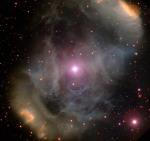 NGC 6164: A Bipolar Emission Nebula
6.06.2006
How did a star form this beautiful nebula? In the middle of emission nebula NGC 6164-5 is an unusually massive star nearing the end of its life. The star, visible in the center...
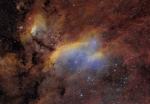 IC 4628: The Prawn Nebula
20.10.2006
South of Antares, in the tail of the nebula-rich constellation Scorpius, lies emission nebula IC 4628. Nearby hot, massive stars, millions of years young, radiate the nebula with invisible ultraviolet light, stripping electrons from atoms. The electrons eventually recombine with the atoms to produce the visible nebular glow.
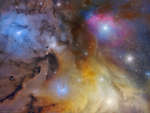 Stars, Dust, and Gas Near Antares
26.01.2022
Why is the sky near Antares and Rho Ophiuchi so dusty yet colorful? The colors result from a mixture of objects and processes. Fine dust -- illuminated from the front by starlight -- produces blue reflection nebulae. Gaseous clouds whose atoms are excited by ultraviolet starlight produce reddish emission nebulae.
 NGC 1360: The Robin's Egg Nebula
5.08.2023
This pretty nebula lies some 1,500 light-years away, its shape and color in this telescopic view reminiscent of a robin's egg. The cosmic cloud spans about 3 light-years, nestled securely within the boundaries of the southern constellation Fornax. Recognized as a planetary nebula, egg-shaped NGC 1360 doesn't represent a beginning though.
|
January February March April May June July August September October |
|||||||||||||||||||||||||||||||||||||||||||||||||