
|
You entered: orbit
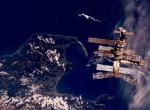 Mir Dreams
26.08.2000
This dream-like image of Mir was recorded by astronauts as the Space Shuttle Atlantis approached the Russian space station prior to docking during the STS-76 mission. Sporting spindly appendages and solar panels...
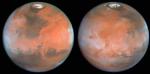 Bound For Mars
22.05.1997
Two NASA spacecraft, Mars Global Surveyor and Mars Pathfinder, are presently approaching the red planet. Pathfinder is scheduled to land on July 4th and Global Surveyor due to enter orbit in September. Recent studies...
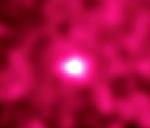 Gamma Ray Moon
27.05.2006
If you could see gamma rays - photons with a million or more times the energy of visible light - the Moon would appear brighter than the Sun! The startling notion is demonstrated by this image...
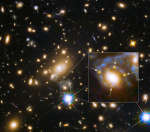 Galaxy and Cluster Create Four Images of Distant Supernova
8.03.2015
What are the unusual spots surrounding that galaxy? They are all images of the same supernova. For the first time, a single supernova explosion has been seen split into multiple images by the gravitational lens deflections of intervening masses. In this case the masses are a large galaxy and its home galaxy cluster.
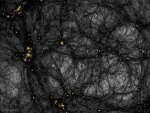 Dark Matter in a Simulated Universe
31.10.2021
Is our universe haunted? It might look that way on this dark matter map. The gravity of unseen dark matter is the leading explanation for why galaxies rotate so fast, why galaxies orbit clusters...
 APOD: 2024 February 12 Б HFG1 & Abell 6: Planetary Nebulae
12.02.2024
Planetary nebulae like Heckathorn-Fesen-Gull 1 (HFG1) and Abell 6 in the constellation Cassiopeia are remnants from the last phase of a medium sized star like our Sun. In spite of their shapes, planetary nebulae have nothing in common with actual planets.
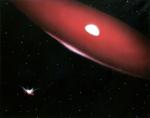 Phi Persei: Double Star
12.12.1997
It's clear who is the biggest star in this binary system. Based on recent results, this artist's vision of the double star Phi Persei, 720 light years away, shows a bright, rapidly rotating massive star surrounded by a disk of gas. A small companion star orbits 100 million miles away.
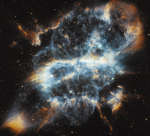 NGC 5189: An Unusually Complex Planetary Nebula
19.12.2012
Why is this nebula so complex? When a star like our Sun is dying, it will cast off its outer layers, usually into a simple overall shape. Sometimes this shape is a sphere, sometimes a double lobe, and sometimes a ring or a helix.
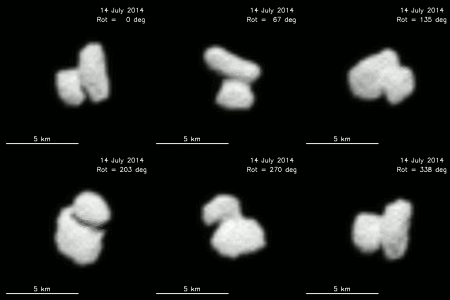 Spacecraft Rosetta Shows Comet has Two Components
21.07.2014
Why does this comet's nucleus have two components? The surprising discovery that Comet 67P/ChuryumovGerasimenko has a double nucleus came late last week as ESA's robotic interplanetary spacecraft Rosetta continued its approach toward the ancient comet's core.
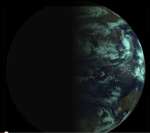 Earth at Equinox
22.09.2014
Earth is at equinox. Over the next 24 hours, day and night have nearly equal duration all over planet Earth. Technically, equinox transpires at 2:29 am Universal Time tomorrow, but this occurs today in North and South America.
|
January February March April May June July August September |
|||||||||||||||||||||||||||||||||||||||||||||||||