
|
You entered: orbit
 APOD: 2024 May 24 Б M78 from the Euclid Space Telescope
24.05.2024
Star formation can be messy. To help find out just how messy, ESA's new Sun-orbiting Euclid telescope recently captured the most detailed image ever of the bright star forming region M78. Near...
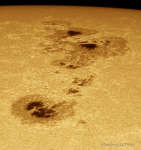 APOD: 2026 June 28 Б AR 4478: Giant Sunspot Group
28.06.2026
Right now, one of the largest sunspot groups in recent history is crossing the Sun. Active Region 4478 is not only big -- it's violent, showing tangled magnetic fields capable of throwing off huge clouds of particles into the Solar System. Some of these CMEs might impact the Earth.
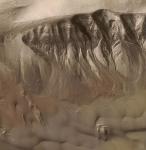 Gullies on Mars
24.10.2002
The Gullies of Mars would probably not have been sensational enough for the title of a vintage Edgar Rice Burroughs story about the Red Planet. But it would get the attention of planetary scientists today.
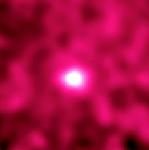 The Gamma Ray Moon
10.02.1997
What if you could see gamma rays (photons with more than 40 million times the energy of visible light)? If you could, the Moon would appear brighter than the Sun! This startling notion...
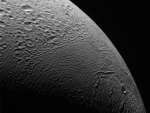 Thirty Thousand Kilometers Above Enceladus
17.03.2008
What does the surface of Saturn's ice-spewing moon Enceladus look like? To help find out, the robotic Cassini spacecraft now orbiting Saturn was sent soaring past the cryovolcanic moon and even right through one of Enceladus' ice plumes. Cassini closed to about 52 kilometers during its closest encounter to date.
 Perseid Below
10.08.2012
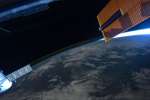
Denizens of planet Earth watched last year's Perseid meteor shower by looking up into the bright moonlit night sky. But this remarkable view captured on August 13, 2011 by astronaut Ron Garan looks down on a Perseid meteor.
 The North America Nebula in Infrared
28.07.2019
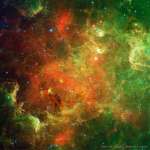
The North America Nebula can do what most North Americans cannot -- form stars. Precisely where in the nebula these stars are forming has been mostly obscured by some of the nebula's thick dust that is opaque to visible light.
 Analemma over the Callanish Stones
18.09.2022
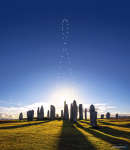
If you went outside at the same time every day and took a picture that included the Sun, how would the Sun's position change? A more visual answer to that question is an analemma, a composite image taken from the same spot at the same time over the course of a year.
 X Ray Mystery in RCW 38
27.12.2002
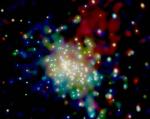
A mere 6,000 light-years distant and sailing through the constellation Vela, star cluster RCW 38 is full of powerful stars. It's no surprise that these stars, only a million years young with hot outer atmospheres, appear as point-like x-ray sources dotting this x-ray image from the orbiting Chandra Observatory.
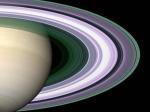 Particle Sizes in Saturns Rings
25.05.2005
What size particles compose Saturn's rings? To help find out, the robot Cassini spacecraft now orbiting Saturn broadcast radio waves of three different wavelengths right through the rings to Earth earlier this month.
|
January February March April May June July August September |
|||||||||||||||||||||||||||||||||||||||||||||||||