
|
You entered: dust
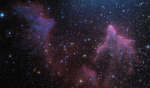 IC 59 and IC 63 in Cassiopeia
3.11.2011
These bright rims and flowing shapes suggest to some melting ice cream on a cosmic scale. Looking toward the constellation Cassiopeia, the colorful (zoomable) skyscape features the swept back, comet-shaped clouds IC 59 (left) and IC 63.
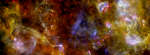 Herschel s Cygnus X
17.05.2012
The Herschel Space Observatory's infrared view of Cygnus X spans some 6x2 degrees across one of the closest, massive star forming regions in the plane of our Milky Way galaxy. In fact, the rich stellar nursery already holds the massive star cluster known as the Cygnus OB2 association.
 The Cloudy Cores of Active Galaxies
24.02.2014
What would it look like to travel to the center of an active galaxy? Most galactic centers are thought to house black holes millions of times more massive than our Sun. The spaces surrounding...
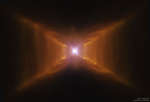 The Red Rectangle Nebula from Hubble
9.05.2018
How was the unusual Red Rectangle nebula created? At the nebula's center is an aging binary star system that surely powers the nebula but does not, as yet, explain its colors. The unusual...
 Quadrantids over the Great Wall
3.01.2020
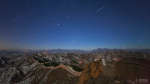
Named for a forgotten constellation, the Quadrantid Meteor Shower is an annual event for planet Earth's northern hemisphere skygazers The shower's radiant on the sky lies within the old, astronomically obsolete constellation Quadrans Muralis. That location is not far from the Big Dipper, at the boundaries of the modern constellations Bootes and Draco.
 Supernova in NGC 2525
23.10.2020
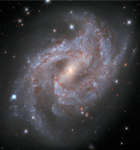
Big, beautiful, barred spiral galaxy NGC 2525 lies 70 million light-years from the Milky Way. It shines in Earth's night sky within the boundaries of the southern constellation Puppis. About 60,000 light-years...
 APOD: 2024 December 9 Б Pleiades: The Seven Sisters Star Cluster
9.12.2024
Have you ever seen the Pleiades star cluster? Even if you have, you probably have never seen it as large and clear as this. Perhaps the most famous star cluster on the sky, the bright stars of the Pleiades can be seen with the unaided eye even from the depths of a light-polluted city.
 NGC 300: A Cosmic Gemstone with Stars and Gas Clouds
16.07.2026
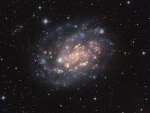
This sparkling, colorful gemstone is a spiral galaxy, NGC 300. It is one of the closest spiral galaxies to Earth, only about 6 million light-years away. But does it really look like this? Here is a more standard portrait of it.
 The Colors and Mysteries of Centaurus A
12.08.2002
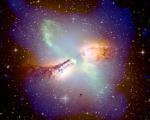
Why is spiral galaxy Centaurus A in so much turmoil? The above composite image shows different clues to the unusual galaxy's past in different bands of light. In low energy radio waves, shown in red, lobes across the thick swath of dust glow brightly.
 Star Forming Region NGC 3582
28.04.2008
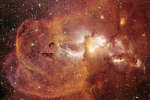
What's happening in the NGC 3582 nebula? Bright stars and interesting molecules are forming. The complex nebula resides in the star forming region called RCW 57. Visible in this image are dense knots...
|
January February March April May June July August September October |
|||||||||||||||||||||||||||||||||||||||||||||||||