
|
You entered: dust
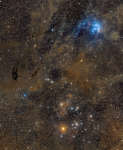 Pleiades to Hyades
5.12.2019
This cosmic vista stretches almost 20 degrees from top to bottom, across the dusty constellation Taurus. It begins at the Pleiades and ends at the Hyades, two star clusters recognized since antiquity in Earth's night sky. At top, the compact Pleiades star cluster is about 400 light-years away.
 Just Another Day on Aerosol Earth
17.04.2020
It was just another day on aerosol Earth. For August 23, 2018, the identification and distribution of aerosols in the Earth's atmosphere is shown in this dramatic, planet-wide digital visualization. Produced in real...
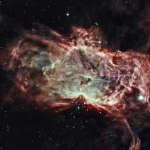 Inside the Flame Nebula
16.04.2021
The Flame Nebula is a stand out in optical images of the dusty, crowded star forming regions toward Orion's belt and the easternmost belt star Alnitak, a mere 1,400 light-years away. Alnitak is the bright star at the right edge of this infrared image from the Spitzer Space Telescope.
 Protostellar Outflows in Serpens
26.06.2024
Jets of material blasting from newborn stars, are captured in this James Webb Space Telescope close-up of the Serpens Nebula. The powerful protostellar outflows are bipolar, twin jets spewing in opposite directions. Their directions are perpendicular to accretion disks formed around the spinning, collapsing stellar infants.
 APOD: 2025 March 5 Б Seven Sisters versus California
4.03.2025
On the right, dressed in blue, is the Pleiades. Also known as the Seven Sisters and M45, the Pleiades is one of the brightest and most easily visible open clusters on the sky. The Pleiades contains over 3,000 stars, is about 400 light years away, and only 13 light years across.
 APOD: 2025 March 11 Б NGC 1672: Barred Spiral Galaxy from Hubble
10.03.2025
Many spiral galaxies have bars across their centers. Even our own Milky Way Galaxy is thought to have a modest central bar. Prominently barred spiral galaxy NGC 1672, featured here, was captured in spectacular detail in an image taken by the orbiting Hubble Space Telescope.
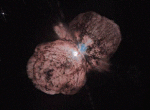 Doomed Star Eta Carinae
12.07.1997
Eta Carinae may be about to explode. But no one knows when - it may be next year, it may be one million years from now. Eta Carinae's mass - about 100 times greater than our Sun - make it an excellent candidate for a full blown supernova.
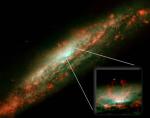 The Bubbling Cauldron of NGC 3079
22.08.2001
Edge-on spiral galaxy NGC 3079 is a mere 50 million light-years away toward the constellation Ursa Major. Shown in this stunning false-color Hubble Space Telescope image, the galaxy's disk - composed of spectacular star clusters in winding spiral arms and dramatic dark lanes of dust - spans some 70,000 light-years.
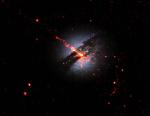 X Ray Jet From Centaurus A
28.10.1999
Spanning over 25,000 light-years, comparable to the distance from the Sun to the center of our own Milky Way galaxy, a cosmic jet seen in X-rays blasts from the center of Centaurus A. Only 10 million light-years away, Centaurus A is a giant elliptical galaxy - the closest active galaxy to Earth.
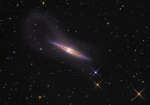 NGC 4013 and the Tidal Stream
6.02.2008
Nearly 50 million light-years away in the constellation Ursa Major, NGC 4013 was long considered an isolated island universe. Seen edge-on, the gorgeous spiral galaxy was known for its flattened disk and central bulge of stars, cut by silhouetted dust lanes.
|
January February March April May June July August September October |
|||||||||||||||||||||||||||||||||||||||||||||||||