
|
You entered: dark
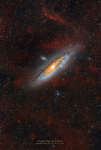 Clouds of Andromeda
4.01.2017
The beautiful Andromeda Galaxy is often imaged by planet Earth-based astronomers. Also known as M31, the nearest large spiral galaxy is a familiar sight with dark dust lanes, bright yellowish core, and spiral arms traced by blue starlight.
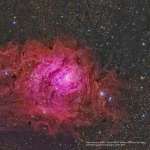 Pan STARRS Across the Lagoon
25.04.2019
Ridges of glowing interstellar gas and dark dust clouds inhabit the turbulent, cosmic depths of the Lagoon Nebula. Also known as M8, the bright star forming region is about 5,000 light-years distant.
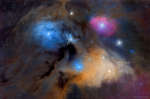 The Colorful Clouds of Rho Ophiuchi
14.10.2020
The many spectacular colors of the Rho Ophiuchi (oh'-fee-yu-kee) clouds highlight the many processes that occur there. The blue regions shine primarily by reflected light. Blue light from the Rho Ophiuchi star system and nearby stars reflects more efficiently off this portion of the nebula than red light.
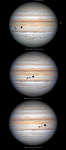 Triple Transit and Mutual Events
21.08.2021
These three panels feature the Solar System's ruling gas giant Jupiter on August 15 as seen from Cebu City, Phillipines, planet Earth. On that date the well-timed telescopic views detail some remarkable performances, transits and mutual events, by Jupiter's Galilean moons.
 Europa and Jupiter from Voyager 1
17.07.2022
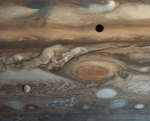
What are those spots on Jupiter? Largest and furthest, just right of center, is the Great Red Spot -- a huge storm system that has been raging on Jupiter possibly since Giovanni Cassini's likely notation of it 357 years ago. It is not yet known why this Great Spot is red.
 Planet Building in HD 100546
2.05.2001
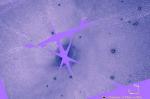
More than 100 billion boulders may be swarming in the disk around nearby star HD 100546. In a scene thought similar to the early years of our own Solar System, ever larger rocks are growing by colliding and accreting dust as the messy business of planet formation appears to be underway.
 A Lucky Lunar Eclipse
3.04.1996
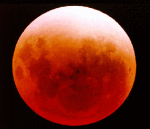
Tonight's full moon would normally washout the spectacle of Comet Hyakutake's lovely tail, even for those far from light polluted skies. Except that tonight comet observers are in luck - the dance of the planets calls for a total lunar eclipse! Lunar eclipses are caused when the Moon passes through the Earth's shadow.
 The Whale Galaxy
2.05.2009
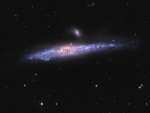
NGC 4631 is a big beautiful spiral galaxy. Seen edge-on, it lies only 25 million light-years away in the well-trained northern constellation Canes Venatici. The galaxy's slightly distorted wedge shape suggests to some a cosmic herring and to others its popular moniker, The Whale Galaxy.
 The Arms of M106
6.02.2013
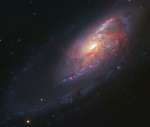
The spiral arms of bright galaxy M106 sprawl through this remarkable multiframe portrait, composed of data from ground- and space-based telescopes. Also known as NGC 4258, M106 can be found toward the northern constellation Canes Venatici. The well-measured distance to M106 is 23.5 million light-years, making this cosmic scene about 80,000 light-years across.
 Airglow, Gegenschein, and Milky Way
20.04.2013
As far as the eye could see, it was a dark night at Las Campanas Observatory in the southern Atacama desert of Chile. But near local midnight on April 11, this mosaic of 3 minute long exposures revealed a green, unusually intense, atmospheric airglow stretching over thin clouds.
|
January February March April May June July August September |
|||||||||||||||||||||||||||||||||||||||||||||||||