
|
You entered: dark
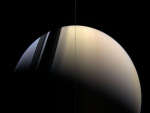 Saturn in Blue and Gold
13.04.2014
Why is Saturn partly blue? The above picture of Saturn approximates what a human would see if hovering close to the giant ringed world. The above picture was taken in 2006 March by the robot Cassini spacecraft now orbiting Saturn. Here Saturn's majestic rings appear directly only as a thin vertical line.
 Contrasting Terrains on Comet Churyumov Gerasimenko
19.08.2014
Where should Philae land? As ESA's robotic spacecraft Rosetta circles toward Comet 67P/ Churyumov-Gerasimenko, a decision must eventually be made as to where its mechanical lander should attempt to touch-down. Reaching the comet...
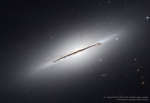 Edge On Galaxy NGC 5866
8.03.2016
Why is this galaxy so thin? Many disk galaxies are actually just as thin as NGC 5866, pictured above, but are not seen edge-on from our vantage point. One galaxy that is situated edge-on is our own Milky Way Galaxy.
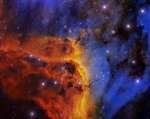 IC 5067 in the Pelican Nebula
25.05.2016
The prominent ridge of emission featured in this sharp, colorful skyscape is cataloged as IC 5067. Part of a larger emission nebula with a distinctive shape, popularly called The Pelican Nebula, the ridge spans about 10 light-years following the curve of the cosmic pelican's head and neck.
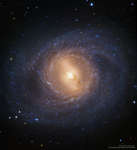 M95: Spiral Galaxy with an Inner Ring
28.05.2019
Why do some spiral galaxies have a ring around the center? First and foremost, M95 is one of the closer examples of a big and beautiful barred spiral galaxy. Visible in the featured combination...
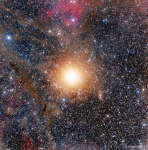 Behind Betelgeuse
10.05.2020
What's behind Betelgeuse? One of the brighter and more unusual stars in the sky, the red supergiant star Betelgeuse can be found in the direction of famous constellation Orion. Betelgeuse, however, is actually...
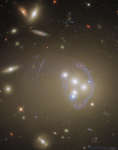 Abell 3827: Cannibal Cluster Gravitational Lens
22.08.2021
Is that one galaxy or three? Toward the right of the featured Hubble image of the massive galaxy cluster Abell 3827 is what appears to be a most unusual galaxy -- curved and with three centers.
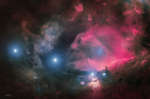 Orions Belt Region in Gas and Dust
10.01.2022
You may have seen Orion's belt before -- but not like this. The three bright stars across this image are, from left to right, Mintaka, Alnilam, and Alnitak: the iconic belt stars of Orion.
 APOD: 2024 March 3 Б A Total Solar Eclipse Close Up in Real Time
2.03.2024
How would you feel if the Sun disappeared? Many eclipse watchers across the USA surprised themselves in 2017 with the awe that they felt and the exclamations that they made as the Sun momentarily disappeared behind the Moon.
 APOD: 2024 July 24 Б Exaggerated Moon
23.07.2024
Our Moon doesn't really have craters this big. Earth's Moon, Luna, also doesn't naturally show this spikey texture, and its colors are more subtle. But this digital creation is based on reality.
|
January February March April May June July August September |
|||||||||||||||||||||||||||||||||||||||||||||||||