
|
You entered: galaxies
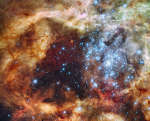 Star Cluster R136 Bursts Out
21.12.2009
In the center of star-forming region 30 Doradus lies a huge cluster of the largest, hottest, most massive stars known. These stars, known collectively as star cluster R136, were captured above in visible light by the newly installed Wide Field Camera peering though the recently refurbished Hubble Space Telescope.
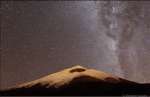 Clouds and Stars over Cotopaxi Volcano in Ecuador
26.05.2010
What's happening above the Cotopaxi volcano in Ecuador? Quite a bit, from the looks of the above one-night, time-lapse movie, taken earlier this month. The majestic volcano is first seen through breaks in fast moving clouds as the movie begins.
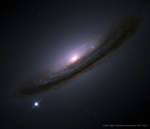 Supernova 1994D and the Unexpected Universe
31.05.2015
Long ago, far away, a star exploded. Supernova 1994D, visible as the bright spot on the lower left, occurred in the outskirts of disk galaxy NGC 4526. Supernova 1994D was not of interest for how different it was, but rather for how similar it was to other supernovae.
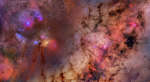 Scorpius Enhanced
16.06.2021
If Scorpius looked this good to the unaided eye, humans might remember it better. Scorpius more typically appears as a few bright stars in a well-known but rarely pointed out zodiacal constellation. To get a spectacular image like this, though, one needs a good camera, a dark sky, and some sophisticated image processing.
 APOD: 2025 May 27 Б Zeta and Rho Ophiuchi with Milky Way
27.05.2025
Behold one of the most photogenic regions of the night sky, captured impressively. Featured, the band of our Milky Way Galaxy runs diagonally along the bottom-left corner, while the colorful Rho Ophiuchi cloud complex is visible just right of center and the large red circular Zeta Ophiuchi Nebula appears near the top.
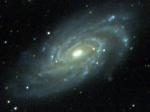 NGC 6070: First Light for Sloan
10.06.1998
The graceful spiral galaxy NGC 6070, 100 million light-years distant in the constellation Serpens, is helping astronomers celebrate "First Light" (the first test sky images) for an exciting new telescope built to perform the ambitious Sloan Digital Sky Survey.
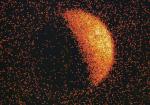 X-Ray Moon
4.10.2003
This x-ray image of the Moon was made by the orbiting ROSAT (Röntgensatellit) Observatory in 1990. In this digital picture, pixel brightness corresponds to x-ray intensity. Consider the image in three parts: the bright hemisphere of the x-ray moon, the darker half of the moon, and the x-ray sky background.
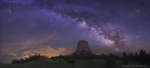 The Milky Way Over Devils Tower
29.07.2009
Was Devil's Tower once an explosive volcano? Famous for its appearance in films such as Close Encounters, the origin of Devil's Tower in Wyoming, USA is still debated, with a leading hypothesis holding that it is a hardened lava plume that probably never reached the surface to become a volcano.
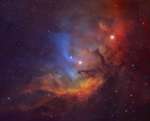 The Tulip in the Swan
26.07.2012
Framing a bright emission region this telescopic view looks out along the plane of our Milky Way Galaxy toward the nebula rich constellation Cygnus the Swan. Popularly called the Tulip Nebula the glowing cloud of interstellar gas and dust is also found in the 1959 catalog by astronomer Stewart Sharpless as Sh2-101.
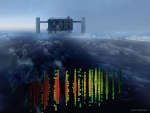 Distant Neutrinos Detected Below Antarctic Ice
1.09.2015
From where do these neutrinos come? The IceCube Neutrino Observatory near the South Pole of the Earth has begun to detect nearly invisible particles of very high energy. Although these rarely-interacting neutrinos pass through much of the Earth just before being detected, where they started remains a mystery.
|
January February March April May June July August September October |
|||||||||||||||||||||||||||||||||||||||||||||||||