
|
You entered: galaxies
 Fermi Science Finals
23.07.2018
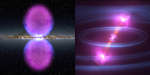
The Fermi Science Playoffs celebrate 10 years of the Fermi Gamma-ray Space Telescope's exploration of the high-energy universe. Surviving all early rounds of voting, these two finalists in the competion square off at last.
 A Northern Winter Sky Panorama
24.12.2019
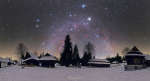
What stars shine in Earth's northern hemisphere during winter? The featured image highlights a number of bright stars visible earlier this month. The image is a 360-degree horizontal-composite panorama of 66 vertical frames taken consecutively with the same camera and from the same location at about 2:30 am.
 APOD: 2023 July 24 Б Chemicals Glow as a Meteor Disintegrates
24.07.2023
Meteors can be colorful. While the human eye usually cannot discern many colors, cameras often can. Pictured here is a fireball, a disintegrating meteor that was not only one of the brightest the photographer has ever seen, but colorful.
 The Radio Sky: Tuned to 408MHz
14.12.1997
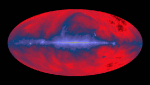
Tune your radio telescope to 408MHz (408 million cycles per second) and check out the Radio Sky! You should find that frequency on your dial somewhere between US broadcast television channels 13 and 14.
 NGC 1499: California Nebula
10.03.2005
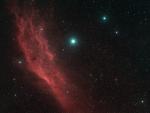
Drifting through the Orion Arm of the spiral Milky Way Galaxy, this cosmic cloud by chance echoes the outline of California on the west coast of the United States. Our own Sun also lies within the Milky Way's Orion Arm, only about 1,500 light-years from the California Nebula.
 Denizen of the Tarantula Nebula
7.04.1999
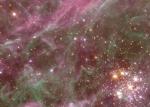
The star cluster at lower right, cataloged as Hodge 301, is a denizen of the Tarantula Nebula. An evocative nebula in the southern sky, the sprawling cosmic Tarantula is an energetic star forming region some 168,000 light-years distant in our neighboring galaxy the Large Magellanic Cloud.
 30 Doradus: The Tarantula Zone
12.12.2005
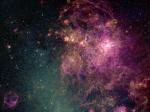
The Tarantula Nebula is more than 1,000 light-years across - a giant emission nebula within our neighboring galaxy the Large Magellanic Cloud. Inside this cosmic arachnid lies a central young cluster of massivestars, cataloged as R136, whose intense radiation and strong winds have helped energize the nebular glow and shape the spidery filaments.
 V4641 Sgr: The Closest Black Hole Candidate
17.01.2000
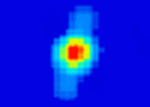
An object many astronomers believe is a black hole has been found only 1500 light-years from Earth, making it the closest black hole candidate. Although dramatic explosions emanate from the object, it is far enough away so that we are in no danger.
 A Dark Sky over Death Valley
8.05.2007
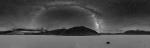
This eerie glow over Death Valley is in danger. Scrolling right will show a spectacular view from one of the darkest places left in the continental USA: Death Valley, California. The above 360-degree full-sky panorama is a composite of 30 images taken two years ago in Racetrack Playa.
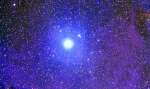 Polaris Dust Nebula
11.01.2008
Centered on North Star Polaris, this 4 degree wide field of view covers part of a complex of relatively unfamiliar, diffuse dust clouds soaring high above the plane of our Milky Way Galaxy.
|
January February March April May June July August September October |
|||||||||||||||||||||||||||||||||||||||||||||||||