
|
You entered: space
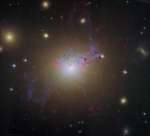 Hubble Remix: Active Galaxy NGC 1275
6.10.2013
Active galaxy NGC 1275 is the central, dominant member of the large and relatively nearby Perseus Cluster of Galaxies. Wild-looking at visible wavelengths, the active galaxy is also a prodigious source of x-rays and radio emission.
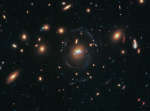 A Blue Bridge of Stars between Cluster Galaxies
15.07.2014
Why is there a blue bridge of stars across the center of this galaxy cluster? First and foremost the cluster, designated SDSS J1531+3414, contains many large yellow elliptical galaxies. The cluster's center...
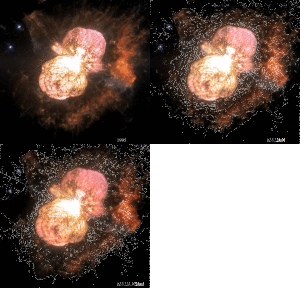 Eta Carinae and the Expanding Homunculus Nebula
1.12.2014
How did the Eta Carinae star system create this unusual expanding nebula? No one knows for sure. About 170 years ago, the southern star system Eta Carinae (Eta Car) mysteriously became the second brightest star system in the night sky. Twenty years later, after ejecting more mass than our Sun, Eta Car unexpectedly faded.
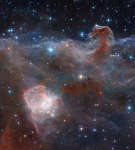 Horsehead: A Wider View
8.03.2018
Combined image data from the massive, ground-based VISTA telescope and the Hubble Space Telescope was used to create this wide perspective of the interstellar landscape surrounding the famous Horsehead Nebula. Captured at near-infrared wavelengths...
 Fortuitous Flash Candidate for the Farthest Star Yet Seen
10.04.2018
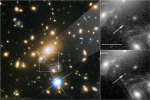
Was this flash the farthest star yet seen? An unexpected flash of light noticed fortuitously on Hubble Space Telescope images may prove to be not only an unusual gravitational lensing event but also an image of a normal star 100 times farther away than any star previously imaged individually.
 The Galaxy, the Jet, and a Famous Black Hole
14.04.2021
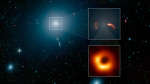
Bright elliptical galaxy Messier 87 (M87) is home to the supermassive black hole captured by planet Earth's Event Horizon Telescope in the first ever image of a black hole. Giant of the Virgo...
 APOD: 2026 March 28 Б Robert Goddard and Nell
27.03.2026
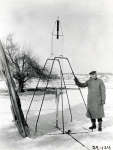
Robert H. Goddard, considered the father of modern rocketry, was born in Worcester Massachusetts in 1882. As a 16 year old, Goddard read H.G. Wells' science fiction classic "War Of The Worlds" and dreamed of space flight. By 1926 he had designed, built, and flown the world's first liquid fuel rocket.
 Elements in the Aftermath
26.10.2001
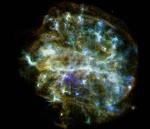
Massive stars spend their brief lives furiously burning nuclear fuel. Through fusion at extreme temperatures and densities surrounding the stellar core, nuclei of light elements like Hydrogen and Helium are combined to heavier elements like Carbon, Oxygen, etc. in a progression which ends with Iron.
 The Magnetic Carpet Of The Sun
5.11.1997
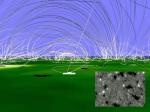
The Sun has a magnetic carpet. Its visible surface appears to be carpeted with tens of thousands of magnetic north and south poles joined by looping field lines which extend outward into the Solar Corona.
 Hoags Object: A Strange Ring Galaxy
15.08.2004
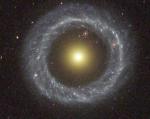
Is this one galaxy or two? This question came to light in 1950 when astronomer Art Hoag chanced upon this unusual extragalactic object. On the outside is a ring dominated by bright blue stars, while near the center lies a ball of much redder stars that are likely much older.
|
January February March April May June July August September |
|||||||||||||||||||||||||||||||||||||||||||||||||