
|
You entered: space
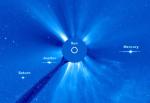 Planets In The Sun
5.05.2000
Today, all five naked-eye planets (Mercury, Venus, Mars, Jupiter, Saturn) plus the Moon and the Sun will at least approximately line-up. As viewed from planet Earth, they will be clustered within about 26 degrees, the closest alignment for all these celestial bodies since February 1962, when there was a solar eclipse!
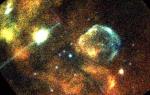 XMM-Newton First Light: X-Rays From The LMC
11.02.2000
Recently the European Space Agency released this and other spectacular "first light" pictures from its new orbiting x-ray observatory, christened XMM-Newton. A churning region of star birth and death in our small neighboring galaxy, the Large Magellanic Cloud (LMC), this field was one of several chosen to test out XMM-Newton's x-ray imaging capabilities.
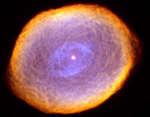 IC 418: The Spirograph Nebula
11.04.2010
What is creating the strange texture of IC 418? Dubbed the Spirograph Nebula for its resemblance to drawings from a cyclical drawing tool, planetary nebula IC 418 shows patterns that are not well understood. Perhaps they are related to chaotic winds from the variable central star, which changes brightness unpredictably in just a few hours.
 Apollo 14: A View from Antares
5.02.2011
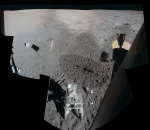
Forty years ago, while looking out the window of Apollo 14's Lunar Module Antares, astronaut Ed Mitchell snapped a series of photos of the lunar surface, assembled into this detailed mosaic by Apollo Lunar Surface Journal editor Eric Jones.
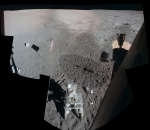 Apollo 14: A View from Antares
4.02.2021
Fifty years ago this Friday, Apollo 14's Lunar Module Antares landed on the Moon. Toward the end of the stay astronaut Ed Mitchell snapped a series of photos of the lunar surface while looking out a window, assembled into this detailed mosaic by Apollo Lunar Surface Journal editor Eric Jones.
 Messier 45: The Daughters of Atlas and Pleione
5.01.2023
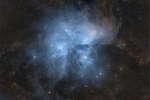
Hurtling through a cosmic dust cloud a mere 400 light-years away, the lovely Pleiades or Seven Sisters open star cluster is well-known for its striking blue reflection nebulae. It lies in the night sky toward the constellation Taurus and the Orion Arm of our Milky Way galaxy.
 APOD: 2023 November 8 Б Perseus Galaxy Cluster from Euclid
8.11.2023
There's a new space telescope in the sky: Euclid. Equipped with two large panoramic cameras, Euclid captures light from the visible to the near-infrared. It took five hours of observing for Euclid...
 A High Energy Fleet
25.11.2000
Like a fleet of futuristic starcruisers, NASA's highly successful series of High Energy Astrophysical Observatory (HEAO) spacecraft appear poised over planet Earth. Labeled A, B, and C in this vintage illustration, the spacebased telescopes were known as HEAO-1, HEAO-2, and HEAO-3 respectively.
 Apollo 17 s Moonship
5.01.2002
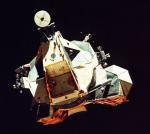
Awkward and angular looking, Apollo 17's lunar module Challenger was designed for flight in the vacuum of space. This sharp picture from the command module America, shows Challenger's ascent stage in lunar orbit.
 Cyclone on Mars
20.05.1999
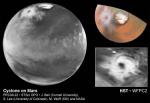
Late last month a team of Mars-watching astronomers sighted an immense cyclonic storm system raging near the Red Planet's north pole. Their discovery picture, made with the Hubble Space Telescope on April 27, is seen at left while the projected insets (right) show closeups of the storm and surrounding areas.
|
January February March April May June July August September |
|||||||||||||||||||||||||||||||||||||||||||||||||