
|
You entered: color
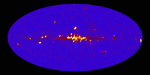 The X-Ray Sky
1.01.1996
What if you could see X-rays? If you could, the night sky would be a strange and unfamiliar place. X-rays are about 1,000 times more energetic than visible light photons and are produced in violent and high temperature astrophysical environments.
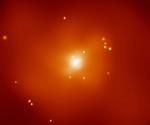 Dark Matter, X rays, and NGC 720
26.10.2002
Elliptical galaxy NGC 720 is enveloped in a cosmic cloud of x-ray emitting gas. Seen in this false color image from the Chandra X-ray Observatory, the extreme temperature of the gas - about 7 million...
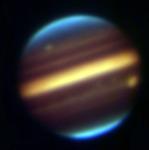 WIRO at Jupiter
12.03.2003
Gazing out over the mountaintops from the Wyoming InfraRed Observatory (WIRO), astronomers recently recorded this bizarre looking image of the solar system's ruling planet, gas giant Jupiter. The false-color picture is a composite...
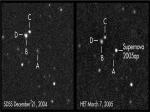 SN 2005ap: The Brightest Supernova Yet Found
16.10.2007
What could cause a bang this big? This supernova explosion was so inherently bright that it could be seen nearby 5 billion light years away (a redshift of 0.28) even with a small telescope.
 Comet and Orion
2.10.2009
These colorful panels both feature a familiar northern hemisphere astronomical sight: the stellar nursery known as the Great Orion Nebula. They also offer an intriguing and unfamiliar detail of the nebula rich skyscape -- a passing comet.
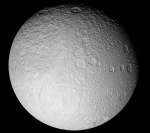 Ice Moon Tethys from Saturn Orbiting Cassini
7.12.2009
What processes formed the unusual surface of Saturn's moon Tethys? To help find out, NASA sent the robotic Cassini spacecraft right past the enigmatic ice moon in 2005. Pictured above is one of the highest resolution images of an entire face of Tethys yet created.
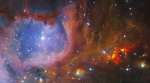 Messier 43
9.07.2015
Often imaged but rarely mentioned, Messier 43 is a large star forming region in its own right. It's just part of the star forming complex of gas and dust that includes the larger, more famous neighboring Messier 42, the Great Orion Nebula.
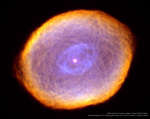 IC 418: The Spirograph Nebula
10.06.2017
What is creating the strange texture of IC 418? Dubbed the Spirograph Nebula for its resemblance to drawings from a cyclical drawing tool, planetary nebula IC 418 shows patterns that are not well understood. Perhaps they are related to chaotic winds from the variable central star, which changes brightness unpredictably in just a few hours.
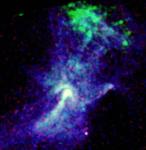 X Rays And The Circinus Pulsar
13.09.2001
A bizarre stellar corpse 19,000 light-years from Earth, pulsar PSR B1509-58 beckons from the small southern constellation of Circinus. Like its cousin at the heart of the Crab nebula, the Circinus pulsar is a rapidly spinning, magnetized neutron star.
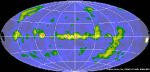 The COMPTEL Gamma-Ray Sky
29.05.1996
This premier gamma-ray view of the sky was produced by the COMPTEL instrument onboard NASA's orbiting Compton Gamma Ray Observatory. The entire sky is seen projected on a coordinate system centered on our Milky Way Galaxy with the plane of the Galaxy running across the middle of the picture.
|
January February March April May June July August September October |
|||||||||||||||||||||||||||||||||||||||||||||||||