
|
You entered: color
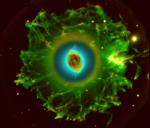 Halo of the Cat's Eye
1.11.2003
The Cat's Eye Nebula (NGC 6543) is one of the best known planetary nebulae in the sky. Its haunting symmetries are seen in the very central region of this stunning false-color picture, processed...
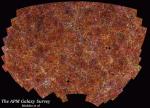 Two Million Galaxies
7.10.2007
Our universe is filled with galaxies. Galaxies -- huge conglomerations of stars, gas, dust -- and mysterious dark matter are the basic building blocks of the large-scale universe. Although distant galaxies move away from each other...
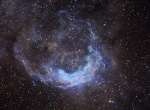 Windblown NGC 3199
22.05.2008
NGC 3199 lies about 12,000 light-years away, a glowing cosmic cloud in the southern constellation of Carina. The nebula is about 75 light-years across in this haunting, false-color view. Though the deep image...
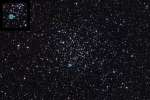 Stars Young and Old
26.03.2009
Galactic or open star clusters are relatively young. These swarms of stars are born near the plane of the Milky Way, but their numbers steadily dwindle as cluster members are strewn through the Galaxy by gravitational interactions.
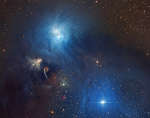 Stars and Dust in Corona Australis
7.01.2015
Cosmic dust clouds and young, energetic stars inhabit this telescopic vista, less than 500 light-years away toward the northern boundary of Corona Australis, the Southern Crown. The dust clouds effectively block light from more distant background stars in the Milky Way.
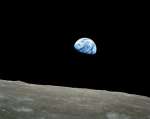 Earthrise: A Video Reconstruction
23.12.2018
About 12 seconds into this video, something unusual happens. The Earth begins to rise. Never seen by humans before, the rise of the Earth over the limb of the Moon occurred 50 years ago tomorrow and surprised and amazed the crew of Apollo 8.
 When Z is for Mars
15.04.2023
A composite of images captured about a week apart from mid August 2022 through late March 2023, this series traces the retrograde motion of ruddy-colored Mars. Progressing from lower right to upper left Mars...
 APOD: 2025 September 11 Б The Umbra of Earth
11.09.2025
The dark, inner shadow of planet Earth is called the umbra. Shaped like a cone extending into space, it has a circular cross section most easily seen during a lunar eclipse.
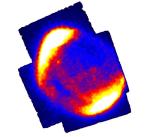 SN 1006: Pieces of the Cosmic Ray Puzzle
2.12.2000
Research balloon flights conducted in 1912 by Austrian physicist Victor Hess revealed that the Earth was constantly bombarded by high energy radiation from space - which came to be called "Cosmic Rays". What are Cosmic Rays and where do they come from?
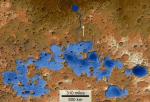 Carving Ma adim Vallis
27.06.2002
Just as erosion from the Colorado River carved the Grand Canyon on Earth, a river of flood water may have carved Ma'adim Vallis, one of the largest canyons on Mars. Researchers have presented...
|
January February March April May June July August September October |
|||||||||||||||||||||||||||||||||||||||||||||||||