
|
You entered: color
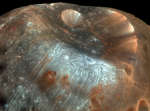 Stickney Crater
5.05.2018
Stickney Crater, the largest crater on the martian moon Phobos, is named for Chloe Angeline Stickney Hall, mathematician and wife of astronomer Asaph Hall. Asaph Hall discovered both the Red Planet's moons in 1877.
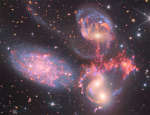 Stephans Quintet from Webb, Hubble, and Subaru
18.07.2022
OK, but why can't you combine images from Webb and Hubble? You can, and today's featured image shows one impressive result. Although the recently launched James Webb Space Telescope (Webb) has a larger mirror than Hubble, it specializes in infrared light and can't see blue -- only up to about orange.
 APOD: 2024 December 30 Б M27: The Dumbbell Nebula
30.12.2024
Is this what will become of our Sun? Quite possibly. The first hint of our Sun's future was discovered inadvertently in 1764. At that time, Charles Messier was compiling a list of diffuse objects not to be confused with comets.
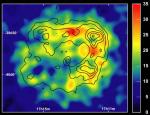 Supernova Remnant Imaged in Gamma Rays
5.11.2004
Gamma rays are the most energetic form of light. With up to a billion times the energy of ordinary "medical" x-rays, they easily penetrate telescope lenses and mirrors, making it very difficult to create gamma-ray images of cosmic sources.
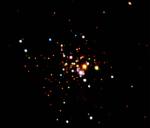 X Ray Stars of 47 Tuc
21.07.2005
Visible light images show the central region of globular cluster 47 Tucanae is closely packed, with stars less than a tenth of a light-year apart. This Chandra false-color x-ray view of central...
 Fresh Tiger Stripes on Saturn's Enceladus
28.06.2009
Do underground oceans vent through the tiger stripes on Saturn's moon Enceladus? Long features dubbed tiger stripes are known to be spewing ice from the moon's icy interior into space, creating a cloud of fine ice particles over the moon's South Pole and creating Saturn's mysterious E-ring.
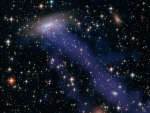 Stripping ESO 137 001
28.03.2014
Spiral galaxy ESO 137-001 hurtles through massive galaxy cluster Abell 3627 some 220 million light years away. The distant galaxy is seen in this colorful Hubble/Chandra composite image through a foreground of the Milky Way's stars toward the southern constellation Triangulum Australe.
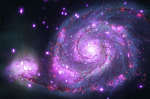 M51: X Rays from the Whirlpool
10.06.2014
What if we X-rayed an entire spiral galaxy? This was done (again) recently by NASA's Chandra X-ray Observatory for the nearby interacting galaxies known as the Whirlpool (M51). Hundreds of glittering x-ray stars are present in the above Chandra image of the spiral and its neighbor.
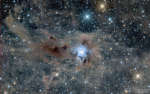 The Iris Nebula in a Field of Dust
1.08.2018
What blue flower grows in this field of dark interstellar dust? The Iris Nebula. The striking blue color of the Iris Nebula is created by light from the bright star SAO 19158 reflecting off of a dense patch of normally dark dust.
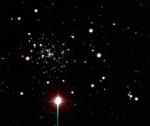 Palomar 13's Last Stand
30.11.2000
Globular star cluster Palomar 13 has roamed the halo of our Milky Way Galaxy for the last 12 billion years. The apparently sparse cluster of stars just left of center in this composite color digital image, it is one of the smallest, faintest globular clusters known.
|
January February March April May June July August September October |
|||||||||||||||||||||||||||||||||||||||||||||||||