
|
You entered: sky
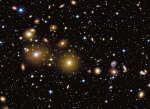 The Perseus Cluster of Galaxies
20.05.2008
Here is one of the largest objects that anyone will ever see on the sky. Each of these fuzzy blobs is a galaxy, together making up the Perseus Cluster, one of the closest clusters of galaxies. The cluster is seen through a foreground of faint stars in our own Milky Way Galaxy.
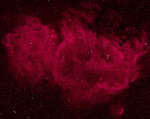 IC 1848: The Soul Nebula
15.04.2013
Stars are forming in the Soul of the Queen of Aethopia. More specifically, a large star forming region called the Soul Nebula can be found in the direction of the constellation Cassiopeia, who Greek mythology credits as the vain wife of a King who long ago ruled lands surrounding the upper Nile river.
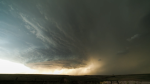 A Supercell Thunderstorm Over Texas
18.06.2013
Is that a cloud or an alien spaceship? It's an unusual and sometimes dangerous type of thunderstorm cloud called a supercell. Supercells may spawn damaging tornados, hail, downbursts of air, or drenching rain. Or they may just look impressive.
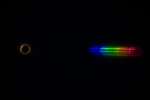 The Flash Spectrum of the Sun
15.11.2013
In a flash, the visible spectrum of the Sun changed from absorption to emission on November 3rd, during the brief total phase of a solar eclipse. That fleeting moment is captured by telephoto lens and diffraction grating in this well-timed image from clearing skies over Gabon in equatorial Africa.
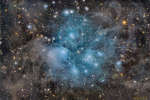 The Pleiades Deep and Dusty
25.02.2014
The well known Pleiades star cluster is slowly destroying part of a passing cloud of gas and dust. The Pleiades is the brightest open cluster of stars on Earth's sky and can be seen from almost any northerly location with the unaided eye.
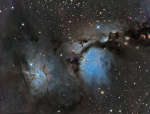 M78 and Reflecting Dust Clouds
26.03.2014
An eerie blue glow and ominous columns of dark dust highlight M78 and other bright reflection nebula in the constellation of Orion. The dark filamentary dust not only absorbs light, but also reflects the light of several bright blue stars that formed recently in the nebula.
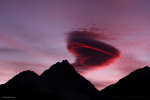 A Heart Shaped Lenticular Cloud
14.02.2016
Can a cloud love a mountain? Perhaps not, but on a Valentine's Day like today, one might be prone to seeing heart-shaped symbols where they don't actually exist. A fleeting pareidolia, the featured heart was really a lenticular cloud that appeared one morning last July above Mount Cook National Park in New Zealand.
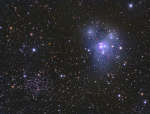 NGC 7129 and NGC 7142
30.08.2019
This wide-field telescopic image looks toward the constellation Cepheus and an intriguing visual pairing of dusty reflection nebula NGC 7129 (right) and open star cluster NGC 7142. The two appear separated by only half a degree on the sky, but they actually lie at quite different distances.
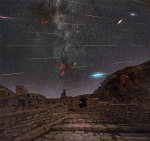 A Meteor Wind over Tunisia
16.08.2022
Does the Earth ever pass through a wind of meteors? Yes, and they are frequently visible as meteor showers. Almost all meteors are sand-sized debris that escaped from a Sun-orbiting comet or asteroid, debris that continues in an elongated orbit around the Sun.
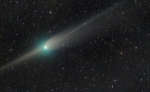 Comet ZTF: Orbital Plane Crossing
27.01.2023
The current darling of the northern night, Comet C/2022 E3 ZTF is captured in this telescopic image from a dark sky location at June Lake, California. Of course Comet ZTF has been growing brighter in recent days, headed for its closest approach to Earth on February 1.
|
January February March April May June July August September October |
|||||||||||||||||||||||||||||||||||||||||||||||||