
|
You entered: dust
 An Unusual Globule in IC 1396
12.12.2022
Is there a monster in IC 1396? Known to some as the Elephant's Trunk Nebula, parts of gas and dust clouds of this star formation region may appear to take on foreboding forms, some nearly human. The only real monster here, however, is a bright young star too far from Earth to hurt us.
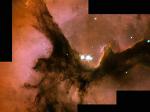 The Trifid Nebula from Hubble
18.06.2004
Clouds of glowing gas mingle with lanes of dark dust in the Trifid Nebula, a star forming region toward the constellation of Sagittarius. In the center, the three huge dark dust lanes that give the Trifid its name all come together.
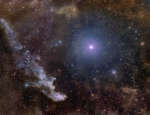 Rigel and the Witch Head Nebula
29.12.2009
Double, double toil and trouble; Fire burn, and cauldron bubble -- maybe Macbeth should have consulted the Witch Head Nebula. This suggestively shaped reflection nebula on the lower left is associated with the bright star Rigel, to its right, in the constellation Orion.
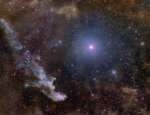 Rigel and the Witch Head Nebula
1.11.2012
Double, double toil and trouble; Fire burn, and cauldron bubble -- maybe Macbeth should have consulted the Witch Head Nebula. The suggestively shaped reflection nebula is associated with the bright star Rigel in the constellation Orion.
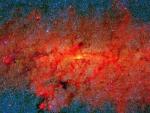 The Galactic Center Across the Infrared
5.07.2000
The center of our Galaxy is obscured in visible light by dark dust that rotates with the stars in the Galactic Plane. In this century, however, sensors have been developed that can detect light more red that humans can see - light called infrared.
 APOD: 2025 September 8 Б IRAS 04302: Butterfly Disk Planet Formation
8.09.2025
This butterfly can hatch planets. The nebula fanning out from the star IRAS 04302+2247 may look like the wings of a butterfly, while the vertical brown stripe down the center may look like the butterfly's body -- but together they indicate an active planet-forming system.
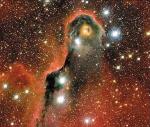 An Unusual Globule in IC 1396
25.03.2002
Is there a monster in IC 1396? Known to some as the Elephant's Trunk Nebula, parts of gas and dust clouds of this star formation region may appear to take on foreboding forms, some nearly human. The only real monster here, however, is a bright young star too far from Earth to hurt us.
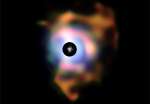 Stardust and Betelgeuse
28.06.2011
An expansive nebula of dust is seen to surround red supergiant star Betegeuse in this remarkable high resolution composite, an infrared VLT image from the European Southern Observatory. Betelgeuse itself is outlined by the small, central red circle. If found in our own solar system its diameter would almost encompass the orbit of Jupiter.
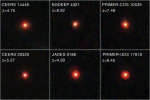 APOD: 2025 December 24 Б Mystery: Little Red Dots in the Early Universe
24.12.2025
What are these little red dots (LRDs)? Nobody knows. Discovered only last year, hundreds of LRDs have now been found by the James Webb Space Telescope in the early universe. Although extremely faint, LRDs are now frequently identified in deep observations made for other purposes.
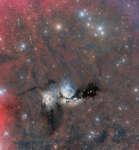 M78 Wide Field
21.01.2021
Interstellar dust clouds and glowing nebulae abound in the fertile constellation of Orion. One of the brightest, M78, is centered in this colorful, wide field view, covering an area north of Orion's belt. At a distance of about 1,500 light-years, the bluish reflection nebula is around 5 light-years across.
|
January February March April May June July August September October |
|||||||||||||||||||||||||||||||||||||||||||||||||