
|
You entered: filaments
 M1: The Incredible Expanding Crab
7.05.2025
Cataloged as M1, the Crab Nebula is the first on Charles Messier's famous list of things which are not comets. In fact, the Crab Nebula is now known to be a supernova remnant, an expanding cloud of debris from the death explosion of a massive star.
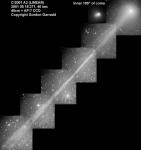 LINEAR s Tail and Two Nuclei
31.05.2001
Arcing toward southern skies in late March, this faint comet LINEAR - the one officially designated C/2001 A2 (LINEAR) - brightened unexpectedly. The outburst, apparently due to the fragmentation of its nucleus, delighted observers as the comet eventually increased to naked-eye brightness.
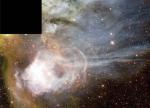 N44C: A Nebular Mystery
14.05.2002
Why is N44C glowing so strangely? The star that appears to powers the nebula, although young and bright, does not seem hot enough to create some of the colors observed. A search for a hidden hotter star in X-rays has come up empty.
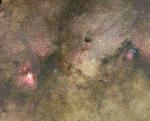 APOD: 2002 September 18- A Sagittarius Starscape
18.09.2002
Many vast star fields in the plane of our Milky Way Galaxy are rich in clouds of stars, dust, and gas. First and foremost, visible in the above picture are millions of stars, many of which are similar to our Sun.
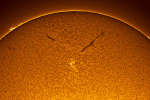 A Sunspot in the New Solar Cycle
5.02.2008
A new cycle has begun on our Sun. Over the past year, the Sun's magnetic field has reset and now a new 11 year period is beginning. Pictured above in a specific color of light emitted by hydrogen is sunspot 10982, one of the first sunspots of the new solar cycle.
 The Lagoon Nebula in High Definition
13.12.2016
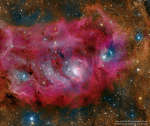
Stars are battling gas and dust in the Lagoon Nebula but the photographers are winning. Also known as M8, this photogenic nebula is visible even without binoculars towards the constellation of Sagittarius. The energetic processes of star formation create not only the colors but the chaos.
 AE Aurigae: The Flaming Star
3.12.2001
Is star AE Aurigae on fire? Although surrounded by what may look like smoke, the object known as the "flaming star" creates energy primarily by nuclear fusion, like other stars. Fire, typically defined...
 SN 1006: Supernova Remnant in X Rays
25.12.2005
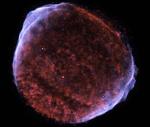
This huge puff ball was once a star. One thousand years ago, in the year 1006, a new star was recorded in the sky that today we know was really an existing star exploding.
 APOD: 2024 July 28 Б Sun Dance
27.07.2024
Sometimes, the surface of our Sun seems to dance. In the middle of 2012, for example, NASA's Sun-orbiting Solar Dynamic Observatory spacecraft imaged an impressive prominence that seemed to perform a running dive roll like an acrobatic dancer.
 Inside the Eagle Nebula
11.06.2002
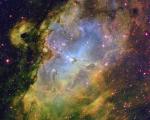
From afar, the whole thing looks like an Eagle. A closer look of the Eagle Nebula, however, shows the bright region is actually a window into the center of a larger dark shell of dust. Through this window, a brightly-lit workshop appears where a whole open cluster of stars is being formed.
|
January February March April May June July August September |
|||||||||||||||||||||||||||||||||||||||||||||||||