
|
You entered: Moon
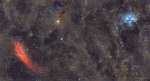 Seven Sisters versus California
5.04.2022
On the upper right, dressed in blue, is the Pleiades. Also known as the Seven Sisters and M45, the Pleiades is one of the brightest and most easily visible open clusters on the sky. The Pleiades contains over 3,000 stars, is about 400 light years away, and only 13 light years across.
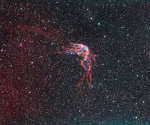 RCW 86: Historical Supernova Remnant
28.05.2022
In 185 AD, Chinese astronomers recorded the appearance of a new star in the Nanmen asterism. That part of the sky is identified with Alpha and Beta Centauri on modern star charts. The new star was visible for months and is thought to be the earliest recorded supernova.
 Shackleton from ShadowCam
5.05.2023
Shackleton crater lies at the lunar south pole. Peaks along the 21 kilometer diameter are in sunlight, but Shackleton's floor is in dark permanent shadow. Still, this image of the shadowed rim wall...
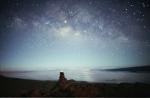 Moonlight, Mars and Milky Way
27.06.2001
Aloha and welcome to a breath-taking skyscape. In this celestial scene, a four day old Moon illuminates a dreamlike foreground while bright planet Mars (above center) rules and the Milky Way's cosmic clouds of stars and dust seem to stretch from horizon to horizon.
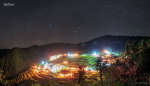 Dark Skies: Turn on the Night
16.05.2019
Have you ever experienced a really dark night sky? One common and amazing feature is the glowing band of our Milky Way galaxy stretching from horizon to horizon. If you live in or near...
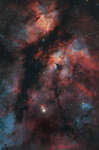 The Gamma Cygni Nebula
18.06.2022
Supergiant star Gamma Cygni is at the center of the Northern Cross. Near the plane of our Milky Way galaxy, that famous asterism flies high in northern summer night skies in the constellation Cygnus the Swan.
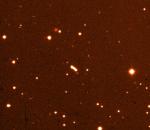 Asteroid 2002 NY40
17.08.2002
Asteroid 2002 NY40 will fly by planet Earth early in the morning August 18 Universal Time (late in the evening August 17 Eastern Daylight Time). Approaching to within about 530,000 kilometers or 1.3 times the Earth-Moon distance 2002 NY40 will definitely not be close enough to pose any danger of collision.
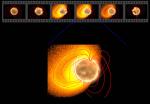 Galactic Magnetar Throws Giant Flare
21.02.2005
Was the brightest Galactic blast yet recorded a key to connecting two types of celestial explosions? Last December, a dense sheet of gamma rays only a few times wider than the Earth plowed through our Solar System, saturating satellites and noticeably reflecting off the Moon.
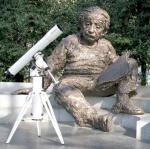 Albert Einstein s Miraculous Year
22.04.2005
In 1905 Albert Einstein had a miraculous year. One hundred years ago, he wrote four papers which revolutionized our understanding of the Universe. The papers outlined; the idea that light could behave...
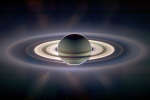 In the Shadow of Saturn
11.01.2009
In the shadow of Saturn, unexpected wonders appear. The robotic Cassini spacecraft now orbiting Saturn recently drifted in giant planet's shadow for about 12 hours and looked back toward the eclipsed Sun. Cassini saw a view unlike any other.
|
January February March April May June July August September October |
|||||||||||||||||||||||||||||||||||||||||||||||||