
|
You entered: Moon
 Cassini Spacecraft Crosses Saturns Ring Plane
23.02.2014
If this is Saturn, where are the rings? When Saturn's "appendages" disappeared in 1612, Galileo did not understand why. Later that century, it became understood that Saturn's unusual protrusions were rings and that when the Earth crosses the ring plane, the edge-on rings will appear to disappear.
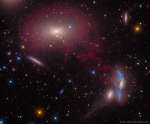 M86 in the Central Virgo Cluster
14.08.2018
Is there a bridge of gas connecting these two great galaxies? Quite possibly, but it is hard to be sure. M86 on the upper left is a giant elliptical galaxy near the center of the nearby Virgo Cluster of galaxies.
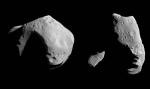 Asteroids
13.03.1998
No asteroid or comet is known to be on a collision course with Earth. The asteroid designated 1997 XF11 had been predicted to come uncomfortably close, but new estimates place its passing beyond the orbit of the Moon. This earth-approaching asteroid was discovered by SpaceWatch astronomer Jim Scotti in December of last year.
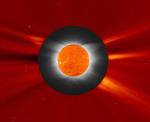 Solar Eclipse and SOHO
31.03.2006
Neither rain, nor snow, nor dark of night can keep the space-based SOlar Heliospheric Observatory (SOHO) from watching the Sun. In fact, from its vantage point 150 million kilometers sunward of planet Earth, SOHO's cameras can always monitor the Sun's outer atmosphere, or corona.
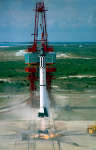 Mercury Redstone 3 Launch
7.05.2021
Sixty years ago, near the dawn of the space age, NASA controllers "lit the candle" and sent Mercury astronaut Alan Shepard arcing into space atop a Redstone rocket. His cramped space capsule was dubbed Freedom 7.
 APOD: 2025 March 5 Б Seven Sisters versus California
5.03.2025
On the right, dressed in blue, is the Pleiades. Also known as the Seven Sisters and M45, the Pleiades is one of the brightest and most easily visible open clusters on the sky. The Pleiades contains over 3,000 stars, is about 400 light years away, and only 13 light years across.
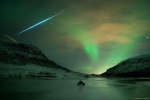 Aurora Shimmer, Meteor Flash
9.12.2018
Some night skies are serene and passive -- others shimmer and flash. The later, in the form of auroras and meteors, haunted skies over the island of Kvaløya, near Tromsø Norway on 2009 December 13. This 30 second long exposure records a shimmering auroral glow gently lighting the wintery coastal scene.
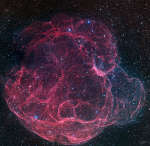 Simeis 147: Supernova Remnant
21.11.2019
It's easy to get lost following the intricate looping filaments in this detailed image of supernova remnant Simeis 147. Also cataloged as Sharpless 2-240 it goes by the popular nickname, the Spaghetti Nebula.
 Simeis 147: Supernova Remnant
10.12.2020
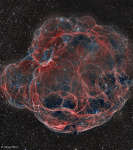
It's easy to get lost following the intricate looping filaments in this detailed image of supernova remnant Simeis 147. Also cataloged as Sharpless 2-240 it goes by the popular nickname, the Spaghetti Nebula.
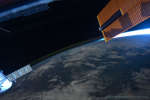 A Perseid Below
8.08.2021
Earthlings typically watch meteor showers by looking up. But this remarkable view, captured on August 13, 2011 by astronaut Ron Garan, caught a Perseid meteor by looking down. From Garan's perspective onboard...
|
January February March April May June July August September October |
|||||||||||||||||||||||||||||||||||||||||||||||||