
|
You entered: Moon
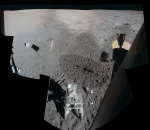 Apollo 14: A View from Antares
5.02.2011
Forty years ago, while looking out the window of Apollo 14's Lunar Module Antares, astronaut Ed Mitchell snapped a series of photos of the lunar surface, assembled into this detailed mosaic by Apollo Lunar Surface Journal editor Eric Jones.
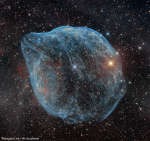 Sharpless 308: The Dolphin-Head Nebula
21.10.2021
Blown by fast winds from a hot, massive star, this cosmic bubble is huge. Cataloged as Sharpless 2-308 it lies some 5,000 light-years away toward the constellation of the Big Dog (Canis Major) and covers slightly more of the sky than a Full Moon.
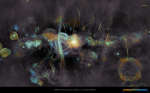 The Galactic Center in Radio from MeerKAT
2.02.2022
What's happening at the center of our galaxy? It's hard to tell with optical telescopes since visible light is blocked by intervening interstellar dust. In other bands of light, though, such as radio, the galactic center can be imaged and shows itself to be quite an interesting and active place.
 APOD: 2023 November 8 Б Perseus Galaxy Cluster from Euclid
8.11.2023
There's a new space telescope in the sky: Euclid. Equipped with two large panoramic cameras, Euclid captures light from the visible to the near-infrared. It took five hours of observing for Euclid...
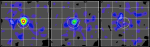 Afterglow
28.05.1998
This sequence of three false color X-ray pictures from the Italian/Dutch BeppoSAX satellite follows the fading glow from a gamma-ray burster. This burster triggered orbiting gamma-ray observatories on December 14, 1997 and within 6.5 hours the sensitive X-ray cameras onboard BeppoSAX had been turned to record the first image (left) of the afterglow.
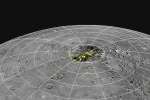 Northern Mercury
1.12.2012
Innermost planet Mercury would probably not be a good location for an interplanetary winter olympics. But new results based on data from the Mercury orbiting MESSENGER spacecraft indicate that it does have substantial water ice in permanently shadowed regions within craters near its north pole.
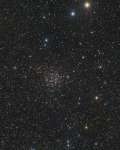 NGC 7789: Caroline s Rose
26.10.2013
Found among the rich starfields of the Milky Way toward the constellation Cassiopeia, star cluster NGC 7789 lies about 8,000 light-years away. A late 18th century deep sky discovery of astronomer Caroline Lucretia Herschel, the cluster is also known as Caroline's Rose.
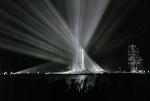 Happy Birthday Jules Verne
17.02.2001
One hundred seventy-three years ago on February 8th, Jules Verne was born in Nantes, France. Inspired by a lifelong fascination with machines, Verne wrote visionary works about "Extraordinary Voyages" including such terrestrial travels as Around the World in 80 Days, Journey to the Centre of the Earth, and Twenty Thousand Leagues Under the Sea.
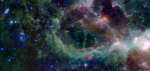 Galaxies Beyond the Heart: Maffei 1 and 2
9.03.2010
The two galaxies on the far left were unknown until 1968. Although they would have appeared as two of the brighter galaxies on the night sky, the opaque dust of the central band of our Milky Way Galaxy had obscured them from being seen in visible light.
 Charon Flyover from New Horizons
14.08.2017
What if you could fly over Pluto's moon Charon -- what might you see? The New Horizons spacecraft did just this in 2015 July as it zipped past Pluto and Charon with cameras blazing.
|
January February March April May June July August September October |
|||||||||||||||||||||||||||||||||||||||||||||||||