
|
You entered: Moon
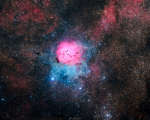 A Beautiful Trifid
5.08.2022
The beautiful Trifid Nebula is a cosmic study in contrasts. Also known as M20, it lies about 5,000 light-years away toward the nebula rich constellation Sagittarius. A star forming region in the plane...
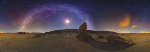 The Milky Way Over Tenerife
5.04.2011
Have you ever seen the band of our Milky Way Galaxy? Chances are you have never seen it like this -- nor could you. In a clear sky from a dark location at the right time, a faint band of light is visible across the sky. This band is the disk of our spiral galaxy.
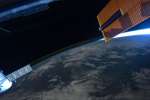 Perseid Below
10.08.2012
Denizens of planet Earth watched last year's Perseid meteor shower by looking up into the bright moonlit night sky. But this remarkable view captured on August 13, 2011 by astronaut Ron Garan looks down on a Perseid meteor.
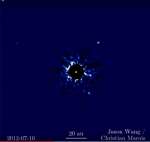 Four Planets Orbiting Star HR 8799
1.02.2017
Does life exist outside our Solar System? To help find out, NASA has created the Nexus for Exoplanet System Science (NExSS) to better locate and study distant star systems that hold hope of harboring living inhabitants.
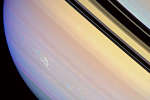 A Persistent Electrical Storm on Saturn
5.05.2008
How do large storms evolve on Saturn? On Earth, a hurricane can persist for weeks, while the Great Red Spot on Jupiter has been in existence for over 150 years. On Saturn, a storm system has now set a new endurance record, now being discernable for greater than three months.
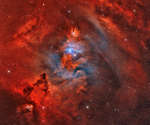 A Fox Fur, a Unicorn, and a Christmas Tree
10.04.2012
What do the following things have in common: a cone, the fur of a fox, and a Christmas tree? Answer: they all occur in the constellation of the unicorn (Monoceros). Pictured above...
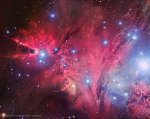 A Fox Fur, a Unicorn, and a Christmas Tree
4.01.2015
What do the following things have in common: a cone, the fur of a fox, and a Christmas tree? Answer: they all occur in the constellation of the unicorn (Monoceros). Pictured as a star...
 Three Galaxies in Draco
1.07.2023
This tantalizing trio of galaxies sometimes called the Draco Group, is located in the northern constellation of (you guessed it) Draco, the Dragon. From left to right are face-on spiral NGC 5985, elliptical galaxy...
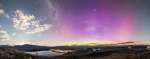 Aurora over New Zealand
26.02.2014
Sometimes the more you look at an image, the more you see. Such may be the case for this beautiful nighttime panorama taken last week in New Zealand. Visible right off, on the far left, are common clouds, slightly altered by the digital fusion of combining 11 separate 20-second exposures.
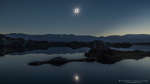 A Total Solar Eclipse Reflected
5.08.2019
If you saw a total solar eclipse, would you do a double-take? One astrophotographer did just that -- but it took a lake and a bit of planning. Realizing that the eclipse would...
|
January February March April May June July August September October |
|||||||||||||||||||||||||||||||||||||||||||||||||