
|
You entered: orbit
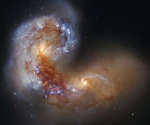 Spiral Galaxy NGC 4038 in Collision
12.08.2012
This galaxy is having a bad millennium. In fact, the past 100 million years haven't been so good, and probably the next billion or so will be quite tumultuous. Visible on the upper...
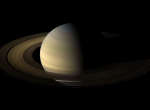 Saturn at Equinox
21.09.2014
How would Saturn look if its ring plane pointed right at the Sun? Before August 2009, nobody knew. Every 15 years, as seen from Earth, Saturn's rings point toward the Earth and appear to disappear.
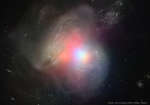 Arp 299: Black Holes in Colliding Galaxies
1.11.2016
Is only one black hole spewing high energy radiation -- or two? To help find out, astronomers trained NASA's Earth-orbiting NuSTAR and Chandra telescopes on Arp 299, the enigmatic colliding galaxies expelling the radiation.
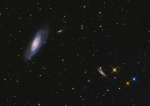 A View Toward M106
1.05.2020
Big, bright, beautiful spiral, Messier 106 dominates this cosmic vista. The nearly two degree wide telescopic field of view looks toward the well-trained constellation Canes Venatici, near the handle of the Big Dipper. Also...
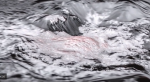 Salt Water Remnants on Ceres
1.09.2020
Does Ceres have underground pockets of water? Ceres, the largest asteroid in the asteroid belt, was thought to be composed of rock and ice. At the same time, Ceres was known to have unusual bright spots on its surface. These bright spots were clearly imaged during Dawn's exciting approach in 2015.
 APOD: 2024 June 30 Б Earthrise: A Video Reconstruction
30.06.2024
About 12 seconds into this video, something unusual happens. The Earth begins to rise. Never seen by humans before, the rise of the Earth over the limb of the Moon occurred about 55.5 years ago and surprised and amazed the crew of Apollo 8.
 APOD: 2025 May 11 Б The Surface of Venus from Venera 14
11.05.2025
If you could stand on Venus -- what would you see? Pictured is the view from Venera 14, a robotic Soviet lander which parachuted and air-braked down through the thick Venusian atmosphere in March of 1982.
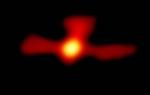 A Galactic Cloud of Antimatter
1.05.1997
The center of our Milky Way Galaxy is full of surprises. Its latest spectacular is a mysterious cloud glowing in gamma rays produced by annihilating antimatter particles! Star Trek fans are all too familiar...
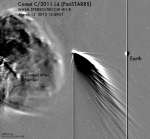 CME, Comet, and Planet Earth
15.03.2013
After appearing in a popular photo opportunity with a young crescent Moon near sunset, naked-eye Comet PanSTARRS continues to rise in northern hemisphere skies. But this remarkable interplanetary perspective from March 13, finds the comet posing with our fair planet itself - as seen from the STEREO Behind spacecraft.
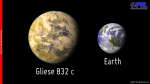 Gliese 832c: The Closest Potentially Habitable Exoplanet
9.07.2014
This planet is only 16 light years away -- could it harbor life? Recently discovered exoplanet Gliese 832c has been found in a close orbit around a star that is less bright than our Sun.
|
January February March April May June July August September |
|||||||||||||||||||||||||||||||||||||||||||||||||