
|
You entered: orbit
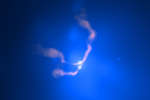 Binary Black Hole in 3C 75
14.03.2010
What's happening in the middle of this massive galaxy? There, two bright sources at the center of this composite x-ray (blue)/radio (pink) image are thought to be co-orbiting supermassive black holes powering the giant radio source 3C 75.
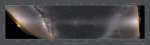 Zodiacal Light Panorama
5.04.2012
Sweeping from the eastern to western horizon, this 360 degree panorama follows the band of zodiacal light along the solar system's ecliptic plane. Dust scattering sunlight produces the faint zodiacal glow that spans...
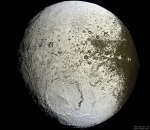 Saturns Iapetus: Painted Moon
3.06.2018
What has happened to Saturn's moon Iapetus? Vast sections of this strange world are dark as coal, while others are as bright as ice. The composition of the dark material is unknown, but infrared spectra indicate that it possibly contains some dark form of carbon.
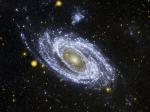 Bright Spiral Galaxy M81 in Ultraviolet from Galex
15.05.2007
Where are the hot stars in M81, one of the closest major spiral galaxies? To help find out, astronomers took a deep image in ultraviolet light of the sprawling spiral with the Earth-orbiting Galex telescope.
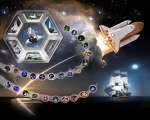 Space Shuttle Tribute Poster: Endeavour
7.09.2010
They are some of the most complex machines ever built. From a standing start they can launch a school- bus sized object up so high and moving so fast that it won't fall back down.
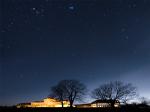 Mira Over Germany
21.02.2007
What's that new star in the sky? The star might appear new, but it's actually just the variable star Mira near its brightest. Rolling your cursor over the above vertically compressed image...
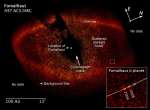 Fomalhaut b
14.11.2008
Fomalhaut (sounds like "foam-a-lot") is a bright, young, star, a short 25 light-years from planet Earth in the direction of the constellation Piscis Austrinus. In this sharp composite from the Hubble Space Telescope, Fomalhaut...
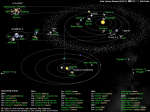 Humanity Explores the Solar System
30.04.2013
What spacecraft is humanity currently using to explore our Solar System? Presently, every inner planet has at least one robotic explorer, while several others are monitoring our Sun, some are mapping Earth's Moon, a few are chasing asteroids and comets, one is orbiting Saturn, and several are even heading out into deep space.
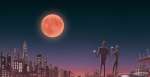 Tonight: A Supermoon Lunar Eclipse
27.09.2015
Tonight a bright full Moon will fade to red. Tonight's moon will be particularly bright because it is reaching its fully lit phase when it is relatively close to the Earth in its elliptical orbit.
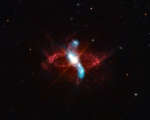 Symbiotic R Aquarii
29.06.2017
A long recognized naked-eye variable star, R Aquarii is actually an interacting binary star system, two stars that seem to have a close, symbiotic relationship. About 710 light years away, it consists of a cool red giant star and hot, dense white dwarf star in mutual orbit around their common center of mass.
|
January February March April May June July August September |
|||||||||||||||||||||||||||||||||||||||||||||||||