
|
You entered: orbit
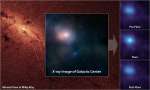 The Black Hole in the Milky Way
2.11.2012
At the center of our Milky Way Galaxy, a mere 27,000 light-years away, lies a black hole with 4 million times the mass of the Sun. Fondly known as Sagittarius A* (pronounced A-star)...
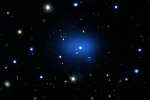 JKCS041: The Farthest Galaxy Cluster Yet Measured
28.10.2009
What if we could see back to the beginning of the universe? We can -- since it takes the age of the universe for light to cross the universe. Peering at distant objects, therefore, tells us about how the universe used to be, even near its beginning.
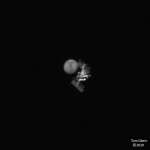 ISS Transits Mars
23.09.2020
Yes, but have you ever seen the space station do this? If you know when and where to look, watching the bright International Space Station (ISS) drift across your night sky is a fascinating sight -- but not very unusual.
 Comet Hyakutake Passes the Earth
25.03.1996
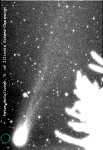
This picture of Comet Hyakutake taken the night of March 21/22 in Illinois, USA shows the enormous tail that has already developed. The silhouette on the right is a foreground tree, and the superposed green circle on the left shows the size of the full moon.
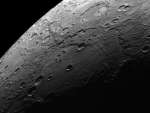 Rembrandt Impact Basin on Mercury
4.05.2009
Why do portions of this huge crater on Mercury have so much iron? The unusual Rembrandt impact basin was discovered recently in images taken during the robotic MESSENGER spacecraft's 2008 October flyby of the Solar System's innermost planet.
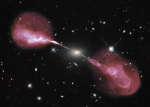 Plasma Jets from Radio Galaxy Hercules A
5.12.2012
Why does this galaxy emit such spectacular jets? No one is sure, but it is likely related to an active supermassive black hole at its center. The galaxy at the image center, Hercules A, appears to be a relatively normal elliptical galaxy in visible light.
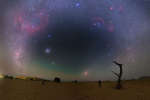 A Gegenschein Lunar Eclipse
14.10.2015
Is there anything interesting to see in the direction opposite the Sun? One night last month, there were quite a few things. First, the red-glowing orb on the lower right of the featured image is the full moon, darkened and reddened because it has entered Earth's shadow.
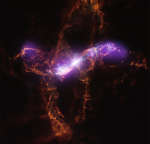 Symbiotic R Aquarii
5.02.2022
Variable star R Aquarii is actually an interacting binary star system, two stars that seem to have a close symbiotic relationship. Centered in this space-based optical/x-ray composite image it lies about 710 light years away.
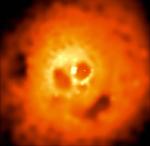 The Perseus Cluster s X Ray Skull
31.10.2000
This haunting image from the orbiting Chandra Observatory reveals the Perseus Cluster of Galaxies in x-rays, photons with a thousand or more times the energy of visible light. Three hundred twenty million light-years distant, the Perseus Cluster contains thousands of galaxies, but none of them are seen here.
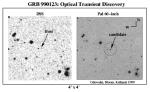 Galaxy And Gamma Ray Burst
25.01.1999
Gamma-ray bursts rule the high-energy sky and Saturday another brief, intense flash of gamma-rays from the cosmos triggered space-based detectors. The orbiting Compton Observatory's BATSE instrument quickly relayed the burst's approximate location to fast-slewing, ground-based cameras primed to search for an elusive optical flash.
|
January February March April May June July August September |
|||||||||||||||||||||||||||||||||||||||||||||||||