
|
You entered: planets
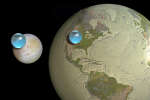 All the Water on Europa
24.05.2012
How much of Jupiter's moon Europa is made of water? A lot, actually. Based on the Galileo probe data acquired during its exploration of the Jovian system from 1995 to 2003, Europa posses a deep, global ocean of liquid water beneath a layer of surface ice.
 M33: Triangulum Galaxy
16.09.2016
The small, northern constellation Triangulum harbors this magnificent face-on spiral galaxy, M33. Its popular names include the Pinwheel Galaxy or just the Triangulum Galaxy. M33 is over 50,000 light-years in diameter, third largest in the Local Group of galaxies after the Andromeda Galaxy (M31), and our own Milky Way.
 Seagull to Sirius
14.12.2016
This broad, beautiful mosaic spans almost 20 degrees across planet Earth's sky. The nebula-rich region lies near the edge of the Orion-Eridanus supperbubble, filled with looping, expanding shells of gas and dust embedded in molecular clouds near the plane of the Milky Way Galaxy.
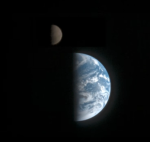 Earth and Moon
3.12.2017
On rare occasions, the Earth and Moon are photographed together. One of most spectacular times this occurred was 25 years ago this month when the Jupiter-bound Galileo spacecraft zoomed past our home planetary system. Then, robotic Galileo watched from about 15-times the Earth-Moon separation as our only natural satellite glided past our home world.
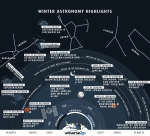 Highlights of the North Winter Sky
4.12.2018
What can you see in the night sky this season? The featured graphic gives a few highlights for Earth's northern hemisphere. Viewed as a clock face centered at the bottom, early (northern) winter sky events fan out toward the left, while late winter events are projected toward the right.
 Solstice to Solstice Solargraph Timelapse
20.12.2019
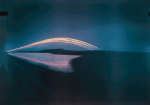
The 2019 December Solstice, on the first day of winter in planet Earth's northern hemisphere and summer in the south, is at 4:19 Universal Time December 22. That's December 21 for North America, though. Celebrate with a timelapse animation of the Sun's seasonal progression through the sky.
 Lyrid Meteors from the Constellation Lyra
11.05.2020
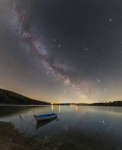
Where are all of these meteors coming from? In terms of direction on the sky, the pointed answer is the constellation of Small Harp (Lyra). That is why the famous meteor shower that peaks every April is known as the Lyrids -- the meteors all appear to came from a radiant toward Lyra.
 Pluto in Enhanced Color
31.07.2021
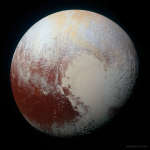
Pluto is more colorful than we can see. Color data and high-resolution images of our Solar System's most famous dwarf planet, taken by the robotic New Horizons spacecraft during its flyby in 2015 July, have been digitally combined to give an enhanced-color view of this ancient world sporting an unexpectedly young surface.
 Spiral Galaxy NGC 2841
22.03.2023
A mere 46 million light-years distant, spiral galaxy NGC 2841 can be found in planet Earth's night sky toward the northern constellation of Ursa Major. This sharp image centered on the gorgeous island universe also captures spiky foreground Milky Way stars and more distant background galaxies within the same telescopic field of view.
 Sharpless 249 and the Jellyfish Nebula
26.02.2026
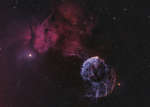
Normally faint and elusive, the Jellyfish Nebula is caught in this alluring telescopic field of view. Floating in the interstellar sea, the nebula is anchored right and left by two bright stars, Mu and Eta Geminorum, at the foot of the celestial twins.
|
January February March April May June July August September October |
|||||||||||||||||||||||||||||||||||||||||||||||||