
|
You entered: planets
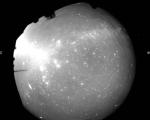 Zodiacal Light and the False Dawn
12.09.2001
An unusual triangle of light will be particularly bright near the eastern horizon before sunrise during the next two months for observers in Earth's northern hemisphere. Once considered a false dawn, this triangle of light is actually Zodiacal Light, light reflected from interplanetary dust particles.
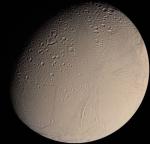 Ski Enceladus
24.01.2002
A small inner moon of Saturn, Enceladus is only about 500 kilometers in diameter. But the cold, distant world does reflect over 90 percent of the sunlight it receives, giving its surface about the same reflectivity as new-fallen snow.
 3D Mars: Northern Terra Meridiani
28.08.2002
In this spectacular 3D stereoscopic view from orbit, steep-sided, flat-topped hills stand above the Terra Meridiani region of Mars. Seen best with red/blue glasses (red for the left eye), the structures are reminiscent of buttes and mesas found in southwestern areas of the North American continent on planet Earth.
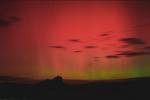 Aurora in Colorado Skies
30.10.2003
Vivid auroral displays were triggered by a cloud of high energy particles from the Sun that collided with planet Earth's magnetosphere yesterday, October 29, at about 06:30 Universal Time. The collision...
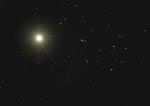 Venus and the Pleiades
15.04.2004
Venus still rules the western skies after sunset as the brilliant evening star. While wandering the ecliptic with its fellow naked-eye planets earlier this month, it passed near the Pleiades star cluster, providing a striking photo opportunity for earthbound skygazers.
 Animation of Asteroids Passing Near Earth
28.03.2006
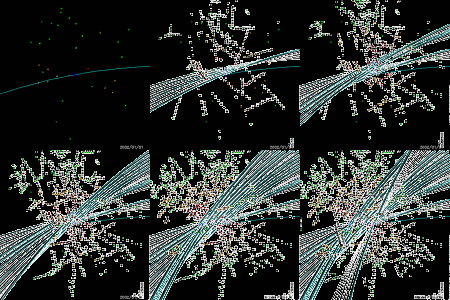
How often does an asteroid whiz by the Earth? The above time-lapse animation follows the orbit of the Earth around the Sun for two months in 2002 as numerous asteroids, also known as minor planets, approach and pass by. Some asteroids appear out of nowhere as they are plotted only when they were discovered.
 Lunar X
11.03.2009
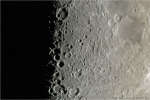
The striking X near the center of this lunarscape is easily visible in binoculars or a small telescope. Yet, not too many have seen it. The catch is, this lunar X is only apparent during a four hour period just before the Moon's first quarter phase.
 Volcanic Terrain on Mercury
27.05.2009
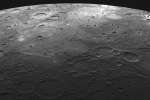
Why are many large craters on Mercury relatively smooth inside? Recent images from the robotic MESSENGER spacecraft that flew by Mercury last October show previously uncharted regions of Mercury that have large craters with an internal smoothness similar to the maria on Earth's own Moon.
 Comet Hartley 2 Flyby
5.11.2010
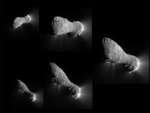
Follow these 5 frames clockwise starting from the top left to track the view from the EPOXI mission spacecraft as it approached, passed under, and then looked back at the nucleus of comet Hartley 2 on November 4. Its closest approach distance was about 700 kilometers.
 Plutos Newly Discovered Moons Receive Names
8.07.2013
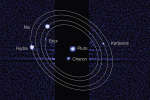
Pluto's newly discovered moons now have names. Known previously as P4 and P5, the International Astronomical Union has now given the fourth and fifth discovered moons of Pluto the names Kerberos and Styx.
|
January February March April May June July August September October |
|||||||||||||||||||||||||||||||||||||||||||||||||