
|
You entered: image
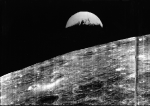 The Earth Also Rises
13.10.1996
The Lunar Orbiter 1 spacecraft was launched in 1966 to map the lunar surface in preparation for the Apollo moon landings. NASA's plucky robotic explorer performed its job well and pioneered this classic view of the Earth poised above the lunar horizon.
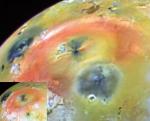 Dark Volcano Active on Io
10.11.1997
The surface of Io is changing even as we watch. The inset frame of Jupiter's most active moon was taken by the robot spacecraft Galileo in April. Just last month the larger image was taken. The new large black spot reveals that a volcano named Pillan Patera has been erupting during the interim.
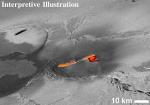 Lava Fountain on Jupiter's Io
20.12.1999
A lava fountain shooting over a kilometer high has been discovered on Jupiter's moon Io. The robot Galileo spacecraft orbiting Jupiter photographed the volcanic eruption during its close flyby of the moon late last month. The fountain is visible in the above mosaic of images from the flyby.
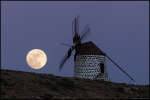 The Windmill s Moon
9.01.2015
Seen from the Canary Island of Fuerteventura, this bright Full Moon rose at sunset. Reaching its full phase on the night of January 4/5, it was the first Full Moon of the new year and the first to follow December's solstice.
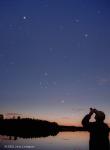 Dusk of the Planets
29.04.2002
A great grouping of planets is now visible to the west just after sunset. Over the next two weeks, Mercury, Venus, Earth, Mars, Jupiter, and Saturn -- all the planets of the inner Solar System -- can be seen in a single knowing glance. The image on the left captured them all in one frame.
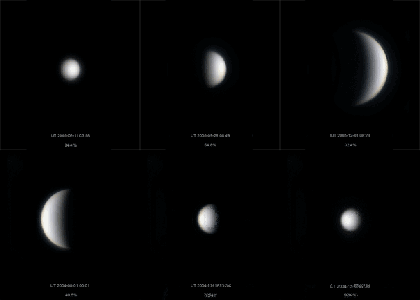 The Phases of Venus
10.01.2006
Venus goes through phases. Just like our Moon, Venus can appear as full as a disk or as a thin as a crescent. Venus, frequently the brightest object in the post-sunset or pre-sunrise sky, appears so small, however, that it usually requires binoculars or a small telescope to clearly see its current phase.
 Eclipse in Seven
11.04.2024
Start at the upper left above and you can follow the progress of April 8's total eclipse of the Sun in seven sharp, separate exposures. The image sequence was recorded with a telescope and camera located within the narrow path of totality as the Moon's shadow swept across Newport, Vermont, USA.
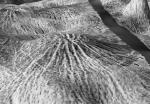 One Hundred Kilometer Terrain on Venus
7.05.2001
Even the hot and cracked surface of Venus has rolling hills. Although never actually photographed from up-close, images of the Venusian surface like that shown above have been constructed in recent years by digitally merging distant photographs with height-sensitive radar. Isolated above is a 100-kilometer wide swath inside a volcanic region known as Yavine Corona.
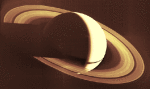 The Night Side of Saturn
5.07.1995
This image of Saturn was made in November 1980 by the Voyager 1 spacecraft as it flew past the ringed gas giant planet. From a spectacular vantage point, looking back toward the inner solar system, the robot spacecraft recorded this view of the night side of Saturn casting a sharp shadow across the bright rings.
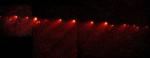 A String Of Pearls
1.08.1998
Comet Shoemaker-Levy 9, named after its co-discoverers, was often referred to as the "string of pearls" comet. It is famous for its suggestive appearance as well as its collision with the planet Jupiter!
|
January February March April May June July August September |
|||||||||||||||||||||||||||||||||||||||||||||||||