
|
You entered: image
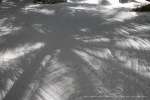 Eclipses in the Shade
23.01.2010
Eclipses are everywhere in this shady scene. The picture was taken on the Indian Ocean atoll island of Ellaidhoo, Maldives, on January 15, during the longest annular solar eclipse for the next 1,000 years. Tall palm trees provided the shade.
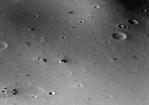 18 Miles From Deimos
22.12.1996
Diminutive Deimos is the smallest of the two tiny Moons of Mars. Potato shaped and barely 6 miles wide this asteroid-like body was visited by the Viking 2 orbiter in 1977. This image was made when the spacecraft approached to within 18 miles of Deimos' surface.
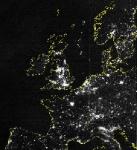 Europe at Night
7.10.1997
This is what Europe looks like at night! Can you find your favorite European city? Although not all of Europe is shown, city lights might make this task possible. Continental outlines have been artificially drawn in yellow. The above picture is actually a composite of over 200 images made by satellites orbiting the Earth.
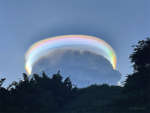 An Iridescent Pileus Cloud over China
6.09.2022
Yes, but how many dark clouds have a multicolored lining? Pictured, behind this darker cloud, is a pileus iridescent cloud, a group of water droplets that have a uniformly similar size and so together diffract different colors of sunlight by different amounts. The featured image was taken last month in Pu'er, Yunnan Province, China.
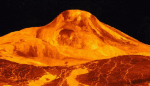 A Venusian Landscape
28.09.1995
This computer generated view of a Venusian volcano was created using data from NASA's Magellan spacecraft. Magellan used its onboard radar to map the surface of Venus which is hidden from telescopic observations by a perpetual cloud cover.
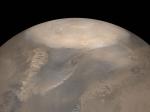 Spring Dust Storms at the North Pole of Mars
24.12.2002
Spring reached the north pole of Mars in May, and brought with it the usual dust storms. As the north polar cap begins to thaw, a temperature difference occurs between the cold frost region and recently thawed surface, resulting in swirling winds between the adjacent regions.
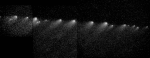 A String Of Pearls
13.07.1995
Comet Shoemaker-Levy 9, named after its co-discoverers, was often referred to as the "string of pearls" comet. It is famous for its unusual appearance as well as its collision with the planet Jupiter!
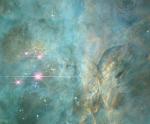 In the Center of the Trapezium
18.11.1997
Start with the constellation of Orion. Below Orion's belt is a fuzzy area known as the Great Nebula of Orion or M42. In this nebula is a bright star cluster known as the Trapezium, shown above. New stellar systems are forming there in gigantic globs of gas and dust known as Proplyds.
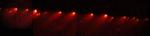 A String Of Pearls
25.05.2002
Comet Shoemaker-Levy 9, named after its co-discoverers, was often referred to as the "string of pearls" comet. It is famous for its suggestive appearance as well as its collision with the planet Jupiter!
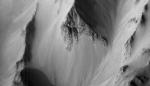 Mars: A Sheer Close Up
13.11.1997
As the Mars Global Surveyor spacecraft maneuvers toward its final mapping orbit, its cameras have been producing some sharp views of Mars. At a resolution of better than 30 feet per pixel, this image...
|
January February March April May June July August September |
|||||||||||||||||||||||||||||||||||||||||||||||||