
|
You entered: galaxies
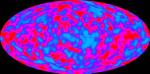 COBE Hotspots: The Oldest Structures Known
7.02.1998
Above is a microwave image of the entire sky. The plane of our galaxy runs horizontally through the center. This historic all-sky map is based on the first two years of data from NASA's COsmic Background Explorer (COBE) satellite.
 The International Ultraviolet Explorer
29.09.1995
The International Ultraviolet Explorer (IUE) was launched by a NASA Delta rocket in 1978 to provide a space telescope for ultraviolet astronomy. A collaborative project among NASA, ESA and the British SRC (now PPARC) agencies, IUE's estimated lifetime was 3 to 5 years.
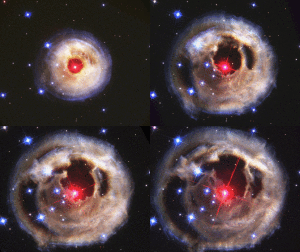 V838 Light Echo: The Movie
2.04.2003
What caused this outburst of V838 Mon? For reasons unknown, star V838 Mon's outer surface suddenly greatly expanded with the result that it became the brightest star in the entire Milky Way Galaxy. Then, just as suddenly, it faded.
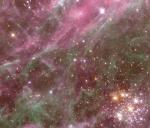 Denizen of the Tarantula Nebula
3.05.2003
The star cluster at lower right, cataloged as Hodge 301, is a denizen of the Tarantula Nebula. An evocative nebula in the southern sky, the sprawling cosmic Tarantula is an energetic star forming region some 168,000 light-years distant in our neighboring galaxy the Large Magellanic Cloud.
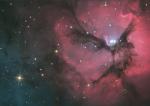 A Beautiful Trifid
1.09.2003
The beautiful Trifid Nebula (aka M20), a photogenic study in cosmic contrasts, lies about 5,000 light-years away toward the nebula rich constellation Sagittarius. A star forming region in the plane of our galaxy...
 A Sky Full Of Hydrogen
1.03.1998
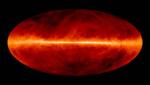
Interstellar space is filled with extremely tenuous clouds of gas which are mostly Hydrogen. The neutral hydrogen atom (HI in astronomer's shorthand) consists of 1 proton and 1 electron. The proton and electron spin like tops but can have only two orientations; spin axes parallel or anti-parallel.
 Cone Nebula Close Up
29.05.2004
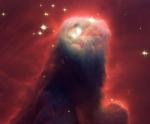
Cones, pillars, and majestic flowing shapes abound in stellar nurseries where natal clouds of gas and dust are buffeted by energetic winds from newborn stars. A well-known example, the Cone Nebula within the bright galactic star-forming region NGC 2264, was captured in this close-up view from the Hubble Space Telescope's Advanced Camera for Surveys.
 A Tale of Two Hemispheres
30.07.2011
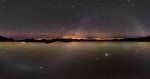
A quest to find planet Earth's darkest night skies led to this intriguing panorama. In projection, the mosaic view sandwiches the horizons visible in all-sky images taken from the northern hemisphere's Canary Island of La Palma (top) and the south's high Atacama Desert between the two hemispheres of the Milky Way Galaxy.
 Barnard Stares at NGC 2170
19.01.2013
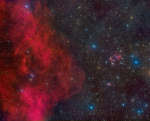
A gaze across a cosmic skyscape, this telescopic mosaic reveals the continuous beauty of things that are. The evocative scene spans some 6 degrees or 12 Full Moons in planet Earth's sky. At the left, folds of red, glowing gas are a small part of an immense, 300 light-year wide arc.
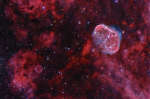 Cygnus: Bubble and Crescent
4.12.2015
These clouds of gas and dust drift through rich star fields along the plane of our Milky Way Galaxy toward the high flying constellation Cygnus. Caught within the telescopic field of view are the Soap Bubble (lower left) and the Crescent Nebula (upper right).
|
January February March April May June July August September October |
|||||||||||||||||||||||||||||||||||||||||||||||||