
|
You entered: galaxies
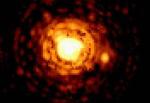 Small Star
20.11.1999
A dim double star system cataloged as Gliese 623 lies 25 light-years from Earth, in the constellation of Hercules. The individual stars of this binary system were distinguished for the first time when the Hubble Space Telescope's Faint Object Camera recorded this image in June 1994.
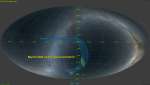 LIGO Virgo GW170814 Skymap
28.09.2017
From around planet Earth three gravitational wave detectors have now reported a joint detection of ripples in spacetime, the fourth announced detection of a binary black hole merger in the distant Universe. The event...
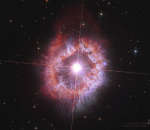 The Outburst Clouds of Star AG Car
26.05.2021
What created these unusual clouds? At the center of this 2021 Hubble image sits AG Carinae, a supergiant star located about 20,000 light-years away in the southern constellation Carina. The star's emitted...
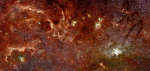 The Galactic Core in Infrared
7.01.2009
What's happening at the center of our Milky Way Galaxy? To help find out, the orbiting Hubble and Spitzer space telescopes have combined their efforts to survey the region in unprecedented detail in infrared light.
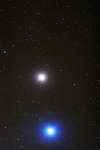 ISON, Mars, Regulus
17.10.2013
In order top to bottom this celestial snapshot features Comet ISON, planet Mars, and Regulus, alpha star of the constellation Leo, in the same frame. The scene spans about 2 degrees near the eastern horizon in early morning skies of October 15.
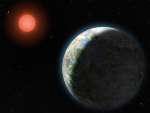 Zarmina s World
1.10.2010
A mere 20 light-years away in the constellation Libra, red dwarf star Gliese 581 has received much scrutiny by astronomers in recent years. Earthbound telescopes had detected the signatures of multiple planets orbiting...
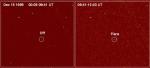 LP 944-20: A Failed Star Flares
13.07.2000
The tiny spot circled on the right actually represents a big astronomical discovery -- the first detected flare from a failed star. Failed stars, termed brown dwarfs in astronomers' parlance, are too low in mass to ignite nuclear hydrogen burning in their cores, yet
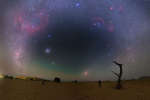 A Gegenschein Lunar Eclipse
14.10.2015
Is there anything interesting to see in the direction opposite the Sun? One night last month, there were quite a few things. First, the red-glowing orb on the lower right of the featured image is the full moon, darkened and reddened because it has entered Earth's shadow.
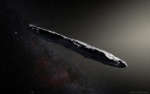 APOD: 2017 November 22 Oumuamua: Interstellar Asteroid
22.11.2017
Nothing like it has ever been seen before. The unusual space rock 'Oumuamua is so intriguing mainly because it is the first asteroid ever detected from outside our Solar System -- although likely many more are to follow given modern computer-driven sky monitoring.
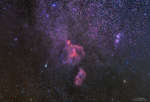 Comet Heart and Soul
23.08.2018
The greenish coma of comet 21P/Giacobini-Zinner stands out at the left of this telephoto skyscape spanning over 10 degrees toward the northern constellations Cassiopeia and Perseus. Captured on August 17, the periodic comet is the known parent body of the upcoming Draconid meteor shower.
|
January February March April May June July August September October |
|||||||||||||||||||||||||||||||||||||||||||||||||