
|
You entered: arcs
 Galaxies Away
25.05.2018
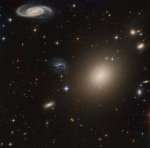
This stunning group of galaxies is far, far away, about 450 million light-years from planet Earth and cataloged as galaxy cluster Abell S0740. Dominated by the cluster's large central elliptical galaxy (ESO 325-G004)...
 Runaway Star
3.12.1997
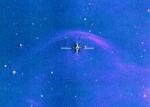
Runaway stars are massive stars traveling rapidly through interstellar space. Like a ship plowing through the interstellar medium, runaway star HD 77581 has produced this graceful arcing bow wave or "bow shock" - compressing the gaseous material in its path.
 The View from Chajnantor
23.11.2011
From an altitude of over 5,000 meters, the night sky view from Chajnantor Plateau in the Chilean Andes is breathtaking in more ways than one. The dark site's rarefied atmosphere, at about 50 percent sea level pressure, is also extremely dry.
 ISS and the Summer Milky Way
24.01.2013
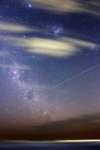
Clouds on a summer night frame this sea and skyscape, recorded earlier this month near Buenos Aires, Argentina. But planet Earth's clouds are not the only clouds on the scene. Starry clouds...
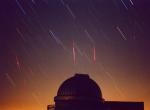 2001 Leonids: Meteors in Perspective
7.11.2002
The 2001 Leonid storm was so intense that the meteor shower's radiant, the point on the sky from which the fleeting trails seemed to diverge, was easy to spot. But the bits of debris that created the meteors really moved along parallel paths, following the orbit of their parent comet Tempel-Tuttle.
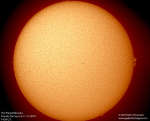 Mercury and the Quiet Sun
14.11.2019
On November 11, 2019 the Sun was mostly quiet, experiencing a minimum in its 11 year cycle of activity. In fact, the only spot visible was actually planet Mercury, making a leisurely 5 1/2 hour transit in front of the calm solar disk.
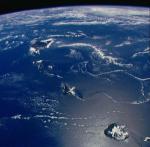 Hawaii
27.04.2002
Aloha! With the graceful arc of Earth's limb in the background, the Hawaiian Island archipelago is visible in this stunning photo taken by the astronauts onboard the shuttle Discovery in October of 1988. Along with popular beaches and tropical resorts, these volcanic islands offer extreme elevations with dark, dry, cloudless skies.
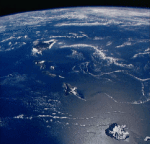 Hawaii
16.12.1995
Aloha! With the graceful arc of the Earth's limb in the background, the entire Hawaiian Island archipelago is visible in this stunning photo taken by the astronauts onboard the shuttle Discovery in October of 1988. Along with popular beaches and tropical resorts, these volcanic islands offer extreme elevations with dark, dry, cloudless skies.
 Hazing Jupiter
9.01.1997
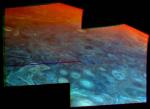
A dramatic mosaic of recent images from the Galileo spacecraft reveals details of swirling clouds and a thick stratospheric haze in the atmosphere of Jupiter, the Solar System's largest planet. This false color...
 The Seagull Nebula
12.01.2011
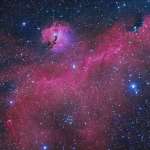
This broad expanse of glowing gas and dust presents a bird-like visage to astronomers from planet Earth, suggesting its popular moniker - The Seagull Nebula. This portrait of the cosmic bird covers a 1.6 degree wide swath across the plane of the Milky Way, near the direction of Sirius, alpha star of the constellation Canis Major.
|
January February March April May June July August September |
|||||||||||||||||||||||||||||||||||||||||||||||||