
|
You entered: arcs
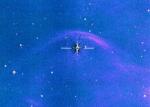 Runaway Star
27.11.1999
Runaway stars are massive stars traveling rapidly through interstellar space. Like a ship plowing through the interstellar medium, runaway star HD 77581 has produced this graceful arcing bow wave or "bow shock" - compressing the gaseous material in its path.
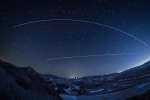 Space Stations in Low Earth Orbit
7.01.2023
On January 3, two space stations already illuminated by sunlight in low Earth orbit crossed this dark predawn sky. Moving west to east (left to right) across the composited timelapse image China's Tiangong Space Station traced the upper trail captured more than an hour before the local sunrise.
 M83: Star Streams and a Thousand Rubies
3.07.2024
Big, bright, and beautiful, spiral galaxy M83 lies a mere twelve million light-years away, near the southeastern tip of the very long constellation Hydra. About 40,000 light-years across, M83 is known as the Southern Pinwheel for its pronounced spiral arms.
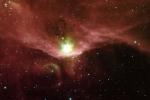 Sharpless 140
20.05.2004
Three young, massive stars will eventually emerge from this natal cloud of dust and gas, but their presence is already revealed in this false-color image from the Spitzer Space Telescope. The picture offers...
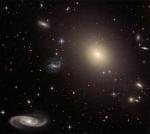 Galaxies Away
8.02.2007
This stunning group of galaxies is far, far away - about 450 million light-years from planet Earth - cataloged as galaxy cluster Abell S0740. Dominated by the cluster's large central elliptical galaxy (ESO 325-G004), this...
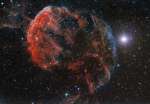 The Elusive Jellyfish Nebula
9.01.2013
Normally faint and elusive, the Jellyfish Nebula is caught in this alluring telescopic view. Drifting near bright star Eta Geminorum, at the foot of a celestial twin, the Jellyfish Nebula is seen dangling tentacles from the bright arcing ridge of emission left of center.
 APOD: 2023 December 26 Б IC 443: The Jellyfish Nebula
26.12.2023
Why is this jellyfish swimming in a sea of stars? Drifting near bright star Eta Geminorum, seen at the right, the Jellyfish Nebula extends its tentacles from the bright arcing ridge of emission left of center.
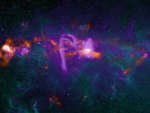 Our Galaxy s Central Molecular Zone
10.11.2008
The central region of our Milky Way Galaxy is a mysterious and complex place. Pictured here in radio and infrared light, the galaxy's central square degree is highlighted in fine detail. The region is known as the Central Molecular Zone.
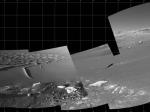 Mosaic of Endurance Crater on Mars
11.10.2004
Where should this Martian rover explore next? Possible choices for the Opportunity rover team on Earth in early August were to send the Martian robot inside Endurance crater toward the arc-shaped sand dunes...
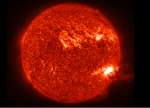 The Sun Unleashed: Monster Filament in Ultraviolet
9.04.2018
One of the most spectacular solar sights is an explosive flare. In 2011 June, the Sun unleashed somewhat impressive, medium-sized solar flare as rotation carried active regions of sunpots toward the solar limb. That...
|
January February March April May June July August September |
|||||||||||||||||||||||||||||||||||||||||||||||||