
|
You entered: ice
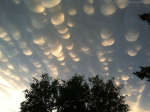 Mammatus Clouds Over Saskatchewan
18.10.2015
Why is this cloud so bubbly? Normally, cloud bottoms are flat. The flatness is caused by moist warm air that rises and cools and so condenses into water droplets at a specific temperature, which usually corresponds to a very specific height. As water droplets grow, an opaque cloud forms.
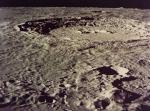 Crater Copernicus
13.05.2001
One of the more prominent craters on the Moon is named Copernicus. Copernicus is a large young crater visible with binoculars slightly northwest of the center of the Moon's Earth-facing hemisphere. Copernicus is distinguished by its size and by the many bright rays pointing out from it.
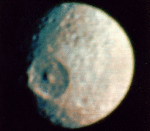 Mimas: Small Moon with A Big Crater
24.09.1995
Mimas is one of the smaller moons of Saturn but shows one of the largest impact craters! In fact, if the impact had been much greater, it would have disrupted the entire satellite. The large crater has been named Herschel after the 1789 discoverer of Mimas, Sir William Herschel.
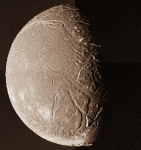 Uranus' Moon Ariel: Valley World
3.03.1996
What formed Ariel's valleys? This question presented itself when Voyager 2 passed this satellite of Uranus in January 1986. Speculation includes that heating caused by the ancient tides of Uranus caused moonquakes and massive shifting of the moon's surface.
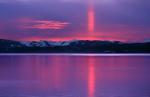 A Sun Pillar in Red and Violet
7.11.2001
Sometimes the unknown is beautiful. In 2000 February near Lake Tahoe, Nevada, two amateur photographers noticed an unusual red column of light rise mysteriously from a setting sun. During the next few minutes, they were able to capture the pillar and a photogenic sunset on film.
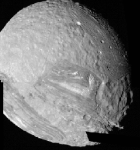 Uranus' Moon Miranda
24.12.1995
NASA's robot spacecraft Voyager 2 passed the planet Uranus and its moons in 1986. While the cloud tops of Uranus proved to be rather featureless, the surface of Miranda, the innermost of Uranus' large moons, showed several interesting features.
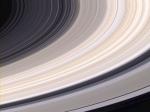 Saturns Rings in Natural Color
23.07.2004
What colors are Saturn's rings? Recent images from the Cassini spacecraft now orbiting Saturn confirm that different rings have slightly different colors. The above image shows their sometimes-subtle differences in brightness and color. The rings reflect sunlight and so, even if they were perfectly reflecting, would appear the color of the Sun.
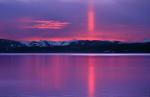 A Sun Pillar in Red and Violet
5.02.2006
Sometimes the unknown is beautiful. In 2000 February near Lake Tahoe, Nevada, two amateur photographers noticed an unusual red column of light rise mysteriously from a setting sun. During the next few minutes, they were able to capture the pillar and a photogenic sunset on film.
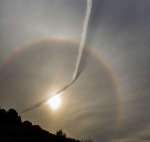 Plane Contrail and Sun Halo
4.04.2017
What's happened to the sky? Several common features of the daytime sky are interacting in uncommon ways. First, well behind the silhouetted hills, is the typically bright Sun. In front...
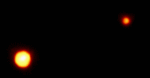 Pluto: The Frozen Planet
18.08.1995
The Hubble Space Telescope imaged Pluto and its moon Charon in 1994. Pluto is usually the most distant planet from the Sun but because of its elliptic orbit Pluto crossed inside of Neptune's orbit in 1979 and will cross back out again in 1999.
|
January February March April May June July August September |
|||||||||||||||||||||||||||||||||||||||||||||||||