
|
You entered: Earth
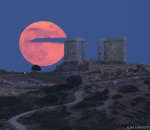 Strawberry Moon over the Temple of Poseidon
18.06.2019
Did you see the full moon last night? If not, tonight's nearly full moon should be almost as good. Because full moons are opposite the Sun, they are visible in the sky when the Sun is not -- which should be nearly all night long tonight, clouds permitting.
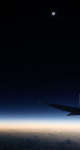 8 Minute and 30 Second Eclipse
6.07.2019
The total phase of the July 2nd solar eclipse lasted about 4 minutes and 30 seconds at the point of maximum eclipse. On the surface of planet Earth, that was about 600 nautical miles north of Easter Island in the Southern Pacific Ocean.
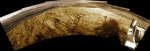 Late Afternoon on Mars
20.12.2019
Shadows grow long near sunset in this wide panoramic view from the Curiosity rover on Mars. Made with Curiosity's navcam, the scene covers about 200 degrees from north through east to south (left to right), stitched together from frames taken by the Mars rover on sol 2616. That's just Earth date December 16.
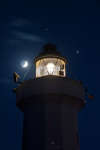 Great Conjunction over Sicilian Lighthouse
8.12.2020
DonБt miss the coming great conjunction. In just under two weeks, the two largest planets in our Solar System will angularly pass so close together in Earth's sky that the Moon would easily be able to cover them both simultaneously. This pending planetary passage -- on December 21 -- will be the closest since 1623.
 Lunar Dust and Duct Tape
14.12.2022
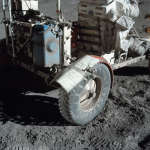
Why is the Moon so dusty? On Earth, rocks are weathered by wind and water, creating soil and sand. On the Moon, the history of constant micrometeorite bombardment has blasted away at the rocky surface creating a layer of powdery lunar soil or regolith.
 APOD: 2023 October 25 Б Gone in 60 Seconds: A Green Flash Sunset
25.10.2023
In 60 seconds, this setting Sun will turn green. Actually, the top of the Sun already appears not only green, but wavey -- along with all of its edges. The Sun itself is unchanged -- both effects are caused by looking along hot and cold layers in Earth's atmosphere.
 183 Days in the Sun
22.12.2023
A single 183 day exposure with a pinhole camera and photographic paper resulted in this long-duration solargraph. Recorded from solstice to solstice, June 21 to December 21, in 2022, it follows the Sun's daily arcing path through planet Earth's skies from Mertola, Portugal.
 APOD: 2024 March 4 Б Light Pillars Over Inner Mongolia
4.03.2024
What's happening across that field? Pictured here are not auroras but nearby light pillars, a phenomenon typically much closer. In most places on Earth, a lucky viewer can see a Sun pillar, a column of light appearing to extend up from the Sun caused by flat fluttering ice-crystals reflecting sunlight from the upper atmosphere.
 A Gargoyles Eclipse
5.04.2025
In dramatic silhouette against a cloudy daytime sky over Paris, France, gargoyles cast their monstrous gaze outward from the west facade of Notre Dame Cathedral. Taken on March 29, this telephoto snapshot also captures the dramatic silhouette of a New Moon against the bright solar disk in a partial solar eclipse.
 APOD: 2026 March 23 Б Light Pillars and Orion over Mohe
23.03.2026
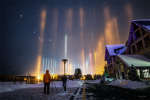
What's happening at the end of that street? Pictured here are not auroras but light pillars, a phenomenon typically much closer. In most places on Earth, a lucky viewer...
|
January February March April May June July August September October |
|||||||||||||||||||||||||||||||||||||||||||||||||