
|
You entered: Earth
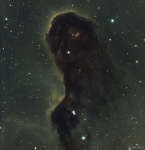 The Dust Monster in IC 1396
2.08.2017
Is there a monster in IC 1396? Known to some as the Elephant's Trunk Nebula, parts of gas and dust clouds of this star formation region may appear to take on foreboding forms, some nearly human. The only real monster here, however, is a bright young star too far from Earth to hurt us.
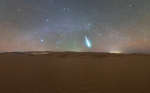 Gemind of the North
17.12.2021
An arid expanse of the Tengger Desert in north-central China, planet Earth fills the foreground of this starry scene. A widefield panoramic view, it was recorded shortly after moonset in the local predawn hours of December 14. Pictured in the still dark sky, stars of the northern winter hexagon surround a luminous Milky Way.
 APOD: 2024 August 20 Б Supermoon Beyond the Temple of Poseidon
20.08.2024
A supermoon occurred yesterday. And tonight's moon should also look impressive. Supermoons appear slightly larger and brighter than most full moons because they reach their full phase when slightly nearer to the Earth -- closer than 90 percent of all full moons.
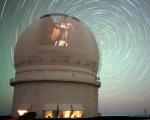 CFHT Star Trails
5.09.2000
High atop a dormant volcano in Hawaii, an eye 3.6-meters wide stares at a faint light on the night sky. Unlike a human eye, which collects light for only a fraction of a second at a time, a telescope such as the Canada-France-Hawaii Telescope (CFHT) can collect light for hours.
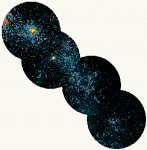 The UV SMC from UIT
20.12.1996
Translated from the "acronese" the title reads - The UltraViolet Small Magellanic Cloud from the Ultraviolet Imaging Telescope. FYI, the four ultraviolet images used in this mosaic of the nearby irregular galaxy known...
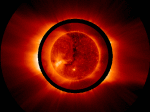 A Wind From The Sun
17.02.1997
A wind from the Sun blows through our Solar System. The behaviour of comet tails as they flapped and waved in this interplanetary breeze gave astronomers the first hint of its existence. Streaming outward...
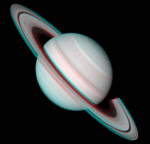 Stereo Saturn
12.02.2000
Get out your red/blue glasses and launch yourself into this stereo picture of Saturn! The picture is actually composed from two images recorded weeks apart by the Voyager 2 spacecraft during its visit to the Saturnian System in August of 1981.
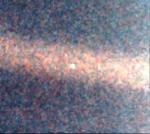 The Largest Rock Known
1.01.1998
There, that faint dot in the center - that's the largest rock known. It is larger than every known asteroid, moon, and comet nucleus. It is larger than any other rocky planet. (Nobody knows...
 A Chicago Meteorite Fall
24.07.2005
If you wait long enough, a piece of outer space itself will come right to you. As Colby Navarro worked innocently on the computer, a rock from space crashed through the roof, struck the printer, banged off the wall, and came to rest near the filing cabinet.
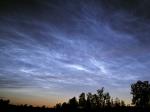 Noctilucent Clouds Over Sweden
18.07.2006
Sometimes it's night on the ground but day in the air. As the Earth rotates to eclipse the Sun, sunset rises up from the ground. Therefore, at sunset on the ground, sunlight still shines on clouds above.
|
January February March April May June July August September October |
|||||||||||||||||||||||||||||||||||||||||||||||||