
|
You entered: NASA
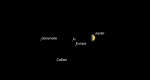 Juno Approaching Jupiter
1.07.2016
Approaching over the north pole after nearly a five-year journey, Juno enjoys a perspective on Jupiter not often seen, even by spacecraft from Earth that usually swing by closer to Jupiter's equator. Looking...
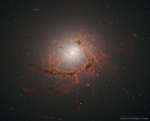 NGC 4696: Filaments around a Black Hole
7.12.2016
What's happening at the center of elliptical galaxy NGC 4696? There, long tendrils of gas and dust have been imaged in great detail as shown by this recently released image from the Hubble Space Telescope.
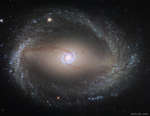 Spiral Galaxy NGC 1512: The Inner Ring
7.08.2017
Most galaxies don't have any rings -- why does this galaxy have two? To begin, the bright band near NGC 1512's center is a nuclear ring, a ring that surrounds the galaxy center and glows brightly with recently formed stars.
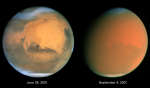 Mars Engulfed
17.06.2018
What's happened to Mars? In 2001, Mars underwent a tremendous planet-wide dust storm -- one of the largest ever recorded from Earth. To show the extent, these two Hubble Space Telescope storm watch images from late June and early September (2001) offer dramatically contrasting views of the martian surface.
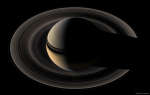 Crescent Saturn
8.08.2020
From Earth, Saturn never shows a crescent phase. But when viewed from a spacecraft the majestic giant planet can show just a sunlit slice. This image of crescent Saturn in natural color was taken by the robotic Cassini spacecraft in 2007.
 Phobos: Moon over Mars
22.03.2024
A tiny moon with a scary name, Phobos emerges from behind the Red Planet in this timelapse sequence from the Earth-orbiting Hubble Space Telescope. Over 22 minutes the 13 separate exposures were captured near the 2016 closest approach of Mars to planet Earth. Martians have to look to the west to watch Phobos rise, though.
 The Solar Corona Unwrapped
5.04.2024
Changes in the alluring solar corona are detailed in this creative composite image mapping the dynamic outer atmosphere of the Sun during two separate total solar eclipses. Unwrapped from the complete circle...
 APOD: 2024 October 22 Б M16: Pillars of Star Creation
22.10.2024
These dark pillars may look destructive, but they are creating stars. This pillar-capturing picture of the Eagle Nebula combines visible light exposures taken with the Hubble Space Telescope with infrared images taken with the James Webb Space Telescope to highlight evaporating gaseous globules (EGGs) emerging from pillars of molecular hydrogen gas and dust.
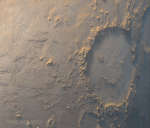 APOD: 2026 February 1 Б Galle: Happy Face Crater on Mars
1.02.2026
Mars has put on a happy face. The Martian crater Galle is famous because it has internal markings that make it look like a face that is both smiling and winking. These markings were originally discovered in the 1970s in pictures taken by the Viking Orbiter.
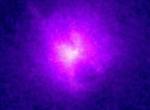 Hot Gas In Hydra A
17.12.1999
The Hydra A galaxy cluster is really big. In fact, such clusters of galaxies are the largest gravitationally bound objects in the Universe. But individual galaxies are too cool to be recorded in this false-color Chandra Observatory X-ray image which shows only the 40 million degree gas that permeates the Hydra A cluster.
|
January February March April May June July August September October |
|||||||||||||||||||||||||||||||||||||||||||||||||