
|
You entered: NASA
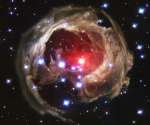 Light Echoes from V838 Mon
4.12.2011
For reasons unknown, star V838 Mon's outer surface suddenly greatly expanded with the result that it became the brightest star in the entire Milky Way Galaxy in January 2002. Then, just as suddenly, it faded. A stellar flash like this has never been seen before.
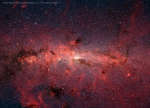 Stars at the Galactic Center
7.03.2015
The center of our Milky Way Galaxy is hidden from the prying eyes of optical telescopes by clouds of obscuring dust and gas. But in this stunning vista, the Spitzer Space Telescope's infrared cameras, penetrate much of the dust revealing the stars of the crowded galactic center region.
 Gamma ray Rain from 3C 279
22.07.2015
If gamma-rays were raindrops a flare from a supermassive black hole might look like this. Not so gently falling on the Fermi Gamma-ray Space Telescope from June 14 to June 16 the gamma-ray photons, with energies up to 50 billion electron volts, originated in active galaxy 3C 279 some 5 billion light-years away.
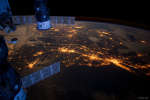 USAs Northeast Megalopolis from Space
24.02.2016
Can you identify a familiar area in the northeast USA just from nighttime lights? It might be possible because many major cities are visible, including (right to left) New York, Philadelphia, Baltimore, Washington, Richmond and Norfolk -- Boston of the USA's Northeast megalopolis is not pictured.
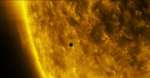 A Mercury Transit Music Video from SDO
11.05.2016
What's that small black dot moving across the Sun? Mercury. Possibly the clearest view of Mercury crossing in front of the Sun earlier this week was from Earth orbit. The Solar Dynamics Observatory obtained an uninterrupted vista recording it not only in optical light but also in bands of ultraviolet light.
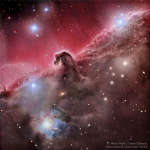 The Magnificent Horsehead Nebula
25.12.2016
Sculpted by stellar winds and radiation, a magnificent interstellar dust cloud by chance has assumed this recognizable shape. Fittingly named the Horsehead Nebula, it is some 1,500 light-years distant, embedded in the vast Orion cloud complex.
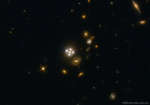 Four Quasar Images Surround a Galaxy Lens
27.02.2017
An odd thing about the group of lights near the center is that four of them are the same distant quasar. This is because the foreground galaxy -- in the center of the quasar images and the featured image -- is acting like a choppy gravitational lens.
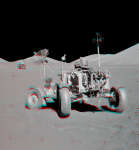 Apollo 17 VIP Site Anaglyph
30.12.2017
Get out your red/blue glasses and check out this stereo scene from Taurus-Littrow valley on the Moon! The color anaglyph features a detailed 3D view of Apollo 17's Lunar Rover in the foreground -- behind it lies the Lunar Module and distant lunar hills.
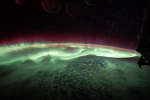 Aurora Slathers Up the Sky
4.01.2020
Like salsa verde on your favorite burrito, a green aurora slathers up the sky in this 2017 June 25 snapshot from the International Space Station. About 400 kilometers (250 miles) above Earth, the orbiting station is itself within the upper realm of the auroral displays.
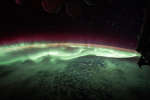 Aurora Slathers Up the Sky
14.01.2021
Like salsa verde on your favorite burrito, a green aurora slathers up the sky in this 2017 June 25 snapshot from the International Space Station. About 400 kilometers (250 miles) above Earth, the orbiting station is itself within the upper realm of the auroral displays.
|
January February March April May June July August September October |
|||||||||||||||||||||||||||||||||||||||||||||||||