
|
You entered: NASA
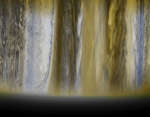 Jupiter's Clouds from New Horizons
23.10.2011
The New Horizons spacecraft took some stunning images of Jupiter on its way out to Pluto. Famous for its Great Red Spot, Jupiter is also known for its regular, equatorial cloud bands, visible through even modest sized telescopes.
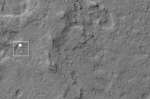 Curiosity Drops In
8.08.2012
Just as it captured the Phoenix lander parachuting to Mars in 2008, the HiRise camera onboard the Mars Reconnaissance Orbiter (MRO) snapped this picture of the Curiosity rover's spectacular descent toward its landing site on August 5 (PDT).
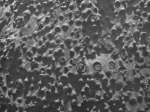 Unusual Spheres on Mars
25.09.2012
Why are these strange little spheres on Mars? The robotic rover Opportunity chanced across these unusually shaped beads earlier this month while exploring a place named Kirkwood near the rim of Mars' Endeavor Crater.
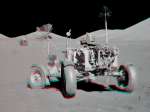 Apollo 17 VIP Site Anaglyph
15.03.2014
Get out your red/blue glasses and check out this stereo scene from Taurus-Littrow valley on the Moon! The color anaglyph features a detailed 3D view of Apollo 17's Lunar Rover in the foreground -- behind it lies the Lunar Module and distant lunar hills.
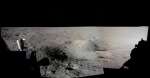 Apollo 11 Landing Site Panorama
19.12.2014
Have you seen a panorama from another world lately? Assembled from high-resolution scans of the original film frames, this one sweeps across the magnificent desolation of the Apollo 11 landing site on the Moon's Sea of Tranquility.
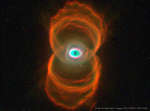 MyCn18: An Hourglass Planetary Nebula
10.05.2015
The sands of time are running out for the central star of this hourglass-shaped planetary nebula. With its nuclear fuel exhausted, this brief, spectacular, closing phase of a Sun-like star's life occurs as its outer layers are ejected - its core becoming a cooling, fading white dwarf.
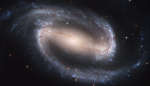 Barred Spiral Galaxy NGC 1300
9.01.2016
Big, beautiful, barred spiral galaxy NGC 1300 lies some 70 million light-years away on the banks of the constellation Eridanus. This Hubble Space Telescope composite view of the gorgeous island universe is one of the largest Hubble images ever made of a complete galaxy.
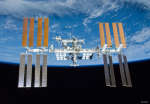 The International Space Station over Earth
18.04.2016
The International Space Station is the largest object ever constructed by humans in space. The station perimeter extends over roughly the area of a football field, although only a small fraction of this is composed of modules habitable by humans.
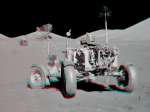 Apollo 17 VIP Site Analglyph
25.11.2016
Get out your red/blue glasses and check out this stereo scene from Taurus-Littrow valley on the Moon! The color anaglyph features a detailed 3D view of Apollo 17's Lunar Rover in the foreground -- behind it lies the Lunar Module and distant lunar hills.
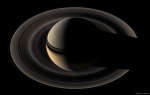 Crescent Saturn
7.07.2019
Saturn never shows a crescent phase -- from Earth. But when viewed from beyond, the majestic giant planet can show an unfamiliar diminutive sliver. This image of crescent Saturn in natural color was taken by the robotic Cassini spacecraft in 2007.
|
January February March April May June July August September October |
|||||||||||||||||||||||||||||||||||||||||||||||||