
|
You entered: NASA
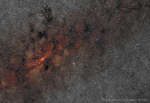 The Galactic Center in Infrared
17.01.2016
The center of our Galaxy is a busy place. In visible light, much of the Galactic Center is obscured by opaque dust. In infrared light, however, dust glows more and obscures less, allowing nearly one million stars to be recorded in the featured photograph.
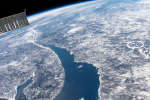 Manicouagan Impact Crater from Space
2.05.2019
Orbiting 400 kilometers above Quebec, Canada, planet Earth, the International Space Station Expedition 59 crew captured this snapshot of the broad St. Lawrence River and curiously circular Lake Manicouagan on April 11. Right of center, the ring-shaped lake is a modern reservoir within the eroded remnant of an ancient 100 kilometer diameter impact crater.
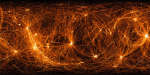 NICER at Night
1.06.2019
A payload on board the International Space Station, the Neutron star Interior Composition Explorer (NICER) twists and turns to track cosmic sources of X-rays as the station orbits planet Earth every 93 minutes. During orbit nighttime, its X-ray detectors remain on.
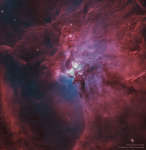 The Lively Center of the Lagoon Nebula
1.06.2020
The center of the Lagoon Nebula is a whirlwind of spectacular star formation. Visible near the image center, at least two long funnel-shaped clouds, each roughly half a light-year long, have been formed by extreme stellar winds and intense energetic starlight. A tremendously bright nearby star, Hershel 36, lights the area.
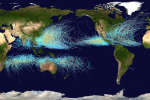 Cyclone Paths on Planet Earth
15.09.2021
Where on Earth do cyclones go? Known as hurricanes when in the Atlantic Ocean and typhoons when in the Pacific, the featured map shows the path of all major storms from 1985 through 2005. The map shows graphically that cyclones usually occur over water, which makes sense since evaporating warm water gives them energy.
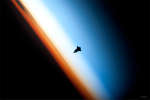 Shuttle Over Earth
17.04.2022
What's that approaching? Astronauts on board the International Space Station in 2010 first saw it far in the distance. Soon it enlarged to become a dark silhouette. As it came even closer, the silhouette appeared to be a spaceship.
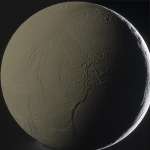 APOD: 2023 February 5 Б Enceladus by Saturnshine
5.02.2023
This moon is shining by the light of its planet. Specifically, a large portion of Enceladus pictured here is illuminated primarily by sunlight first reflected from the planet Saturn. The result is that the normally snow-white moon appears in the gold color of Saturn's cloud tops.
 Planet Earth at Twilight
27.12.2024
No sudden, sharp boundary marks the passage of day into night in this gorgeous view of ocean and clouds over our fair planet Earth. Instead, the shadow line or terminator is diffuse and shows the gradual transition to darkness we experience as twilight.
 APOD: 2025 June 28 Б Lunar Farside
28.06.2025
Tidally locked in synchronous rotation, the Moon always presents its familiar nearside to denizens of planet Earth. From lunar orbit, the Moon's farside can become familiar, though. In fact this sharp picture, a mosaic from the Lunar Reconnaissance Orbiter's wide angle camera, is centered on the lunar farside.
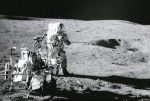 Apollo 14 Deploys ALSEP
10.12.1995
After the lunar module of Apollo 14 set down on the Moon, Astronauts Alan Shepard and Edgar Mitchell deployed the Apollo Lunar Surface Experiments Package (ALSEP) and collected samples of lunar material. The ALSEP scientific experiments included a seismometer sensitive to slight lunar surface movements, and charged particle detectors which measured the solar wind.
|
January February March April May June July August September October |
|||||||||||||||||||||||||||||||||||||||||||||||||