
|
You entered: NASA
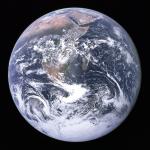 Welcome to Planet Earth
25.03.2007
Welcome to Planet Earth, the third planet from a star named the Sun. The Earth is shaped like a sphere and composed mostly of rock. Over 70 percent of the Earth's surface is water. The planet has a relatively thin atmosphere composed mostly of nitrogen and oxygen.
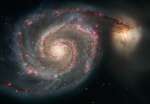 M51: Cosmic Whirlpool
5.01.2008
Follow the handle of the Big Dipper away from the dipper's bowl, until you get to the handle's last bright star. Then, just slide your telescope a little south and west and you might find this stunning pair of interacting galaxies, the 51st entry in Charles Messier's famous catalog.
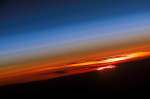 Sunset: Planet Earth
20.03.2008
Today, the Sun crosses the celestial equator heading north at 0548 UT. Known as the equinox, the geocentric astronomical event marks the first day of spring in the northern hemisphere and autumn in the south.
 Noctilucent Clouds Over Germany
24.06.2009
Sometimes it's night on the ground but day in the air. As the Earth rotates to eclipse the Sun, sunset rises up from the ground. Therefore, at sunset on the ground, sunlight still shines on clouds above.
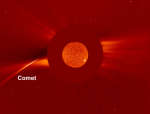 New Year Sun Grazer
16.01.2010
Intense and overwhelming, the direct glare of the Sun is blocked by the smooth occulting disk in this image from the sun-staring SOHO spacecraft. Taken on January 3rd, an extreme ultraviolet image of the Sun to scale, is superimposed at the center of the disk.
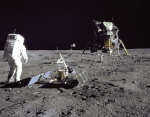 Moonquakes Surprisingly Common
10.10.2010
Why are there so many moonquakes? A recent reanalysis of seismometers left on the moon by the Apollo moon landings has revealed a surprising number of moonquakes occurring within 30 kilometers of the surface. In fact, 28 moonquakes were detected in data recorded between 1972 and 1977.
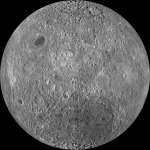 Lunar Farside
9.04.2011
Tidally locked in synchronous rotation, the Moon always presents its familiar nearside to denizens of planet Earth. From lunar orbit, the Moon's farside can become familiar, though. In fact this sharp picture, a mosaic from the Lunar Reconnaissance Orbiter's wide angle camera, is centered on the lunar farside.
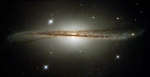 Warped Spiral Galaxy ESO 510 13
4.03.2012
How did spiral galaxy ESO 510-13 get bent out of shape? The disks of many spirals are thin and flat, but not solid. Spiral disks are loose conglomerations of billions of stars and diffuse gas all gravitationally orbiting a galaxy center.
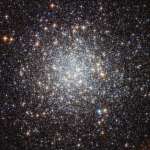 Messier 9 Close Up
23.03.2012
Renown 18th century astronomer Charles Messier described this 9th entry in his famous astronomical catalog as "Nebula, without star, in the right leg of Ophiuchus ...". But Messier 9 (M9) does have stars, known to modern astronomers as a globular cluster of over 300,000 stars within a diameter of about 90 light-years.
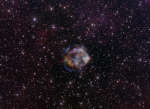 Cas A: Optical and X ray
17.01.2013
The aftermath of a cosmic cataclysm, supernova remnant Cassiopeia A (Cas A) is a comfortable 11,000 light-years away. Light from the Cas A supernova, the death explosion of a massive star, first reached Earth just 330 years ago.
|
January February March April May June July August September October |
|||||||||||||||||||||||||||||||||||||||||||||||||