
|
You entered: NASA
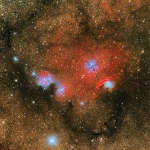 NGC 6559: East of the Lagoon
7.10.2021
Slide your telescope just east of the Lagoon Nebula to find this alluring field of view in the rich starfields of the constellation Sagittarius toward the central Milky Way. Of course the Lagoon nebula is also known as M8, the eighth object listed in Charles Messier's famous catalog of bright nebulae and star clusters.
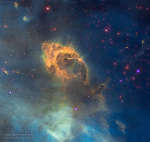 HH 666: Carina Dust Pillar with Jet
14.12.2021
To some, it may look like a beehive. In reality, the featured image from the Hubble Space Telescope captures a cosmic pillar of dust, over two-light years long, inside of which is Herbig-Haro 666 -- a young star emitting powerful jets.
 APOD: 2025 April 15 Б Planetary Nebula NGC 1514 from Webb
15.04.2025
What happens when a star runs out of nuclear fuel? For stars like our Sun, the center condenses into a white dwarf while the outer atmosphere is expelled into space to appear as a planetary nebula.
 APOD: 2025 September 16 Б New Comet SWAN25B over Mexico
16.09.2025
A newly discovered comet is already visible with binoculars. The comet, C/2025 R2 (SWAN) and nicknamed SWAN25B, is brightening significantly as it emerges from the Sun's direction and might soon become visible on your smartphone -- if not your eyes.
 Spiral Eddies On Planet Earth
20.10.1997
Can you identify this stellar nebula? How many light-years from Earth did you say? Looking like a twisting cloud of gas and dust between the stars this wispy nebulosity is actually close by - a spiral eddy formed near the North Atlantic Gulf Stream off the East coast of the US.
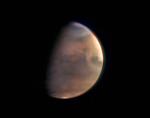 Express to Mars
18.12.2003
Hurtling toward its destination, the high resolution camera on board ESA's Mars Express spacecraft recorded this tantalizing view of the Red Planet earlier this month on December 3rd. Seen from a distance of 5.5 million kilometers, features across part of Mars' western hemisphere are bathed in sunlight.
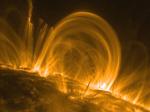 Heating Coronal Loops
14.08.2005
Why is the corona of the Sun so hot? Extending above the photosphere or visible surface of the Sun, the faint, tenuous solar corona can't be easily seen from Earth, but it is measured to be hundreds of times hotter than the photosphere itself.
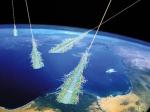 Cosmic Rays
14.08.2006
Have you ever been hit by a beam of high energy particles from above? Surely you have -- it happens all of the time. Showers of high energy particles occur when energetic cosmic rays strike the top of the Earth's atmosphere. Cosmic rays were discovered unexpectedly in 1912.
 Ring Scan
24.10.2007
Scroll right and cruise above the thin, icy rings of Saturn. This high resolution scan is a mosaic of images presented in natural color and recorded in May, over about 2.5 hours as the Cassini spacecraft passed above the unlit side of the rings.
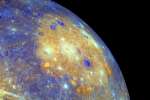 Enhanced Color Caloris
10.07.2008
The sprawling Caloris basin on Mercury is one of the solar system's largest impact basins. Created during the early history of the solar system by the impact of a large asteroid-sized body, the basin spans about 1,500 kilometers and is seen in yellowish hues in this enhanced color mosaic.
|
January February March April May June July August September October |
|||||||||||||||||||||||||||||||||||||||||||||||||