
|
You entered: NASA
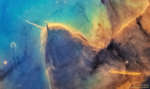 Trifid Pillars and Jets
22.12.2020
Dust pillars are like interstellar mountains. They survive because they are more dense than their surroundings, but they are being slowly eroded away by a hostile environment. Visible in the featured picture...
 Messier 2
19.12.2024
After the Crab Nebula, this giant star cluster is the second entry in 18th century astronomer Charles Messier's famous list of things that are not comets. M2 is one of the largest globular star clusters now known to roam the halo of our Milky Way galaxy.
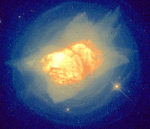 NGC 7027: A Dying Star's Nebula
17.01.1996
This pseudo-color composite of two recent Hubble Space Telescope images is a picture of a Sun-like star nearing the end of its lifetime. The exquisite details visible in this planetary nebula indicate that when...
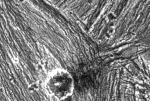 Ganymede: A Really Groovy Moon
11.07.1996
Ganymede's surface is a wrinkled mess. As large ice-sheets shift on the moon's surface, parts of the surface buckle causing high ridges, deep furrows, and parallel grooves. This photo, taken by the Galileo spacecraft currently orbiting Jupiter, was released yesterday. The large circular feature near the picture bottom is a large impact crater.
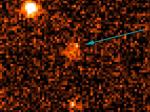 GRB Fireball Persists
17.09.1997
It's still there. The optical counterpart to the instantly famous gamma-ray burst (GRB) that occurred last February 28th has faded - but not completely. The astronomical community had waited patiently for months...
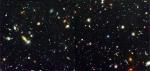 The Hubble Deep Field
7.06.1998
Galaxies like colorful pieces of candy fill the Hubble Deep Field - humanity's most distant yet optical view of the Universe. The dimmest, some as faint as 30th magnitude (about four billion times fainter...
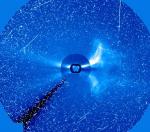 SOHO Composite: Coronal Mass Ejection
20.08.1998
This complex composite image of an ominous and spectacular event - an expanding storm of energetic particles from the Sun - was constructed using data recorded by the SOHO spacecraft on November 6, 1997. Four images...
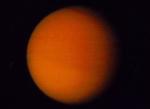 Titan: Saturns Smog Moon
7.02.1999
The largest moon of Saturn is a rare wonder. Titan is the only one of Saturn's moons with an atmosphere, and one of only two moons in the Solar System with this distinction (Neptune's Triton is the other).
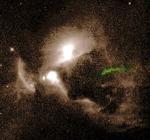 A Disk and Jet in Haro 6-5B
11.02.1999
Planets condense from disks. Several new Hubble Space Telescope pictures of stars surrounded by disks were released earlier this week. Since the glare of the central star usually makes a surrounding disk hard...
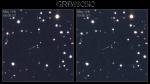 GRB 990510: Another Unusual Gamma Ray Burst
26.05.1999
Another huge explosion has lit up the universe, and astronomers are studying it as best they can before the light fades away. Two weeks ago, the BATSE instrument on the orbiting NASA Great Observatory Compton detected unusually bright flashes of gamma-rays from a point deep in the southern sky.
|
January February March April May June July August September October |
|||||||||||||||||||||||||||||||||||||||||||||||||