
|
You entered: gas
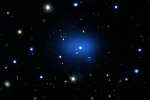 JKCS041: The Farthest Galaxy Cluster Yet Measured
28.10.2009
What if we could see back to the beginning of the universe? We can -- since it takes the age of the universe for light to cross the universe. Peering at distant objects, therefore, tells us about how the universe used to be, even near its beginning.
 APOD: 2025 June 25 Б Rubin's First Look: A Sagittarius Skyscape
25.06.2025
This interstellar skyscape spans over 4 degrees across crowded starfields toward the constellation Sagittarius and the central Milky Way. A First Look image captured at the new NSFБDOE Vera C. Rubin Observatory, the bright nebulae and star clusters featured include famous stops on telescopic tours of the cosmos: Messier 8 and Messier 20.
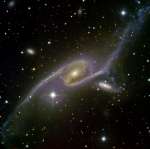 Giant Galaxy NGC 6872
3.04.2011
Over 400,000 light years across NGC 6872 is an enormous spiral galaxy, at least 4 times the size of our own, very large, Milky Way. About 200 million light-years distant, toward the southern...
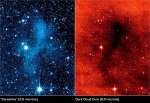 Coreshine from a Dark Cloud
30.09.2010
Stars and their planets are born in cold, dark, interstellar clouds of gas and dust. While exploring the clouds at infrared wavelengths, astronomers have made a surprising discovery -- dozens of cases where dense cloud cores shine by reflecting infrared starlight.
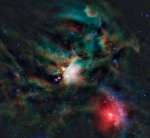 Young Stars in the Rho Ophiuchi Cloud
14.04.2011
Dust clouds and embedded newborn stars glow at infrared wavelengths in this tantalizing false-color composition from WISE, the Wide-field Infrared Survey Explorer. The cosmic canvas features one of the closest star forming regions, part of the Rho Ophiuchi cloud complex some 400 light-years distant near the southern edge of the pronounceable constellation Ophiuchus.
 WR 104: A Pinwheel Star System
3.06.2014
Might this giant pinwheel one-day destroy us? Probably not, but investigation of the unusual star system Wolf-Rayet 104 has turned up an unexpected threat. The unusual pinwheel pattern has been found to be created by energetic winds of gas and dust that are expelled and intertwine as two massive stars orbit each other.
 Galaxy Wars: M81 and M82
20.01.2023
The two dominant galaxies near center are far far away, 12 million light-years distant toward the northern constellation of the Great Bear. On the right, with grand spiral arms and bright yellow core is spiral galaxy M81. Also known as Bode's galaxy, M81 spans some 100,000 light-years.
 X-Rays From Sirius B
6.10.2000
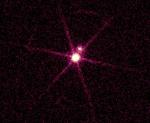
In visible light Sirius A (Alpha Canis Majoris) is the brightest star in the night sky, a closely watched celestial beacon throughout recorded history. Part of a binary star system only 8 light-years away, it was known in modern times to have a small companion star, Sirius B.
 M16: Infrared Star Hunt
4.01.2002
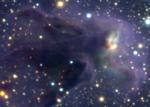
The head of an interstellar gas and dust cloud is shown here in false-color, a near-infrared view recorded by astronomers hunting for stars within M16's Eagle Nebula. Made famous in a 1995 Hubble...
 The Tadpole Galaxy from Hubble
21.06.2021
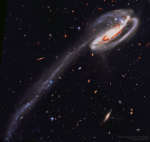
Why does this galaxy have such a long tail? In this stunning vista, based on image data from the Hubble Legacy Archive, distant galaxies form a dramatic backdrop for disrupted spiral galaxy Arp 188, the Tadpole Galaxy. The cosmic tadpole is a mere 420 million light-years distant toward the northern constellation of the Dragon (Draco).
|
January February March April May June July August September October |
|||||||||||||||||||||||||||||||||||||||||||||||||