
|
You entered: star
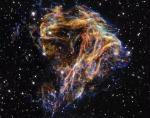 N49 s Cosmic Blast
4.07.2003
Scattered debris from a cosmic supernova explosion lights up the sky in this gorgeous composited image based on data from the Hubble Space Telescope. Cataloged as N49, these glowing filaments of shocked gas span about 30 light-years in our neighboring galaxy, the Large Magellanic Cloud.
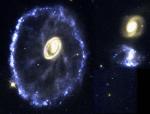 Cartwheel Of Fortune
18.12.1998
By chance, a collision of two galaxies has created a surprisingly recognizable shape on a cosmic scale - "The Cartwheel Galaxy". The Cartwheel is part of a group of galaxies about 500 million light years away in the constellation Sculptor (two smaller galaxies in the group are visible on the right).
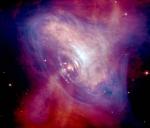 Composite Crab
25.03.2005
(xxxre linkxxx) The Crab Pulsar, a city-sized, magnetized neutron star spinning 30 times a second, lies at the center of this composite image of the inner region of the well-known Crab Nebula. The spectacular...
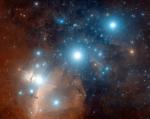 Alnitak, Alnilam, Mintaka
13.10.2005
Alnitak, Alnilam, and Mintaka, are the bright bluish stars from east to west (left to right) along the diagonal in this gorgeous cosmic vista. Otherwise known as the Belt of Orion, these three blue supergiant stars are hotter and much more massive than the Sun.
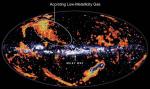 High Velocity Clouds and the Milky Way
13.12.1999
Where are these gas clouds going so quickly? High velocity clouds (HVCs) of gas have been seen for decades but their origins and destinations have remained mysterious. Recent measurements have now placed at least...
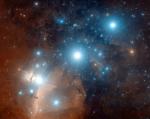 Alnitak, Alnilam, Mintaka
28.12.2006
Alnitak, Alnilam, and Mintaka, are the bright bluish stars from east to west (left to right) along the diagonal in this gorgeous cosmic vista. Otherwise known as the Belt of Orion, these three blue supergiant stars are hotter and much more massive than the Sun.
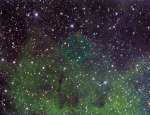 A Bubble in Cygnus
12.11.2008
Adrift in the rich star fields of the constellation Cygnus, this lovely, symmetric bubble nebula was only recently recognized and may not yet appear in astronomical catalogs. In fact, amateur astronomer Dave Jurasevich identified...
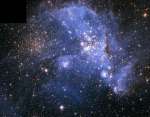 NGC 346 in the Small Magellanic Cloud
17.10.2010
How and why are all these stars forming? Found among the Small Magellanic Cloud's (SMC's) clusters and nebulae NGC 346 is a star forming region about 200 light-years across, pictured above by the Hubble Space Telescope.
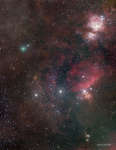 Comet ATLAS and Orion s Belt
11.11.2020
With its closest approach to planet Earth scheduled for November 14, this Comet ATLAS (C/2020 M3) was discovered just this summer, another comet found by the NASA funded Asteroid Terrestrial-impact Last Alert System.
 Aurora Australis and the International Space Station
12.09.2024
This snapshot from the International Space Station was taken on August 11 while orbiting about 430 kilometers above the Indian Ocean, Southern Hemisphere, planet Earth. The spectacular view looks south and east, down toward the planet's horizon and through red and green curtains of aurora australis.
|
January February March April May June July August September October |
|||||||||||||||||||||||||||||||||||||||||||||||||