
|
You entered: Sun
 Along the Taurus Molecular Cloud
23.11.2023
The cosmic brush of star formation composed this interstellar canvas of emission, dust, and dark nebulae. A 5 degree wide telescopic mosaic, it frames a region found north of bright star Aldebaran on the sky, at an inner wall of the local bubble along the Taurus molecular cloud.
 South Pacific Shadowset
24.08.2024
The full Moon and Earth's shadow set together in this island skyscape. The alluring scene was captured Tuesday morning, August 20, from Fiji, South Pacific Ocean, planet Earth. For early morning risers shadowset in the western sky is a daily apparition.
 APOD: 2024 October 6 Б The Magnificent Tail of Comet McNaught
6.10.2024
Comet McNaught, the Great Comet of 2007, grew a spectacularly long and filamentary tail. The magnificent tail spread across the sky and was visible for several days to Southern Hemisphere observers just after sunset. The amazing ion tail showed its greatest extent on long-duration, wide-angle camera exposures.
 The Eclipse and the Stork
3.09.2026
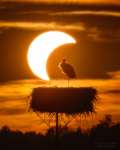
How do animals react to a total solar eclipse? The featured image shows a stork roosting on her nest in Poland at a partial phase of the recent total solar eclipse.
 Doomed Star Eta Carinae
16.08.1998
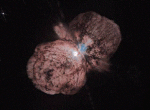
Eta Carinae may be about to explode. But no one knows when - it may be next year, it may be one million years from now. Eta Carinae's mass - about 100 times greater than our Sun - makes it an excellent candidate for a full blown supernova.
 Galileo's Jupiter Probe
7.12.1995
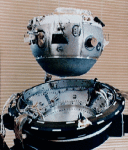
Today, at about 5:00 pm EST, this 750 pound probe from NASA's robot spacecraft Galileo will plummet into Jupiter becoming the first probe to fly through the atmosphere of a gas giant planet.
 The Mysterious Voynich Manuscript
22.01.2005
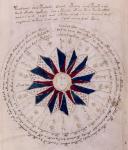
The ancient text has no known title, no known author, and is written in no known language: what does it say and why does it have many astronomy illustrations? The mysterious book was once bought by an emperor, forgotten on a library shelf, sold for thousands of dollars, and later donated to Yale.
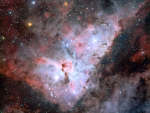 The Great Carina Nebula
16.02.2009
A jewel of the southern sky, the Great Carina Nebula, aka NGC 3372, spans over 300 light-years, one of our Galaxy's largest star forming regions. Like the smaller, more northerly Great Orion Nebula...
 Chasing Carina
26.02.2010
A jewel of the southern sky, the Great Carina Nebula, aka NGC 3372, spans over 300 light-years. Near the upper right of this expansive skycape, it is much larger than the more northerly Orion Nebula.
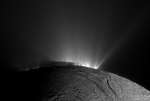 Shadows and Plumes Across Enceladus
4.08.2014
Why does Enceladus have ice plumes? The discovery of jets spewing water vapor and ice was detected by the Saturn-orbiting Cassini spacecraft in 2005. The origin of the water feeding the jets, however, remained a topic of research.
|
January February March April May June July August September October |
|||||||||||||||||||||||||||||||||||||||||||||||||