
|
You entered: Sun
 APOD: 2024 January 28 Б Pluto in True Color
28.01.2024
What color is Pluto, really? It took some effort to figure out. Even given all of the images sent back to Earth when the robotic New Horizons spacecraft sped past Pluto in 2015, processing these multi-spectral frames to approximate what the human eye would see was challenging.
 APOD: 2025 March 3 Б Blue Ghost on the Moon
3.03.2025
There's a new lander on the Moon. Yesterday Firefly Aerospace's Blue Ghost executed the first-ever successful commercial lunar landing. During its planned 60-day mission, Blue Ghost will deploy several NASA-commissioned scientific instruments, including PlanetVac which captures lunar dust after creating a small whirlwind of gas.
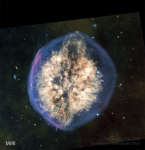 APOD: 2026 March 9 Б The Cranium Nebula from the Webb Telescope
9.03.2026
What's going on inside the head of this nebula? Dubbed the Exposed Cranium Nebula for its similarity to the human brain, what created the nebula remains a mystery. One thought is that the Cranium Nebula, also known as PMR 1, is a planetary nebula surrounding a white dwarf star.
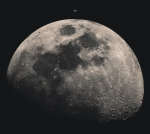 APOD: 2026 April 15 Б The ISS Transits the Moon
15.04.2026
Nope, that is not an alien spaceship landing on the Moon! This is an image of the International Space Station (ISS) as it begins to transit in front of the Moon. The ISS is in low-Earth orbit (LEO) where it wizzes around the Earth every 90 minutes.
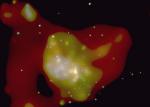 Galactic Center Flicker Indicates Black Hole
10.09.2001
Why would the center of our Galaxy flicker? Many astronomers believe the only credible answer involves a black hole. During observations of Sagittarius A* with the orbiting Chandra X-ray Observatory, the bright X-ray source at the very center of our Milky Way brightened dramatically for a few minutes.
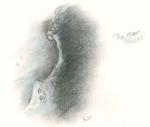 The Moon Maiden
19.06.2003
Along the northwestern reaches of the lunar near side, the Sinus Iridium or Bay of Rainbows appropriately lies at the edge of the Moon's smooth, dark Sea of Rains (Mare Imbrium). In this...
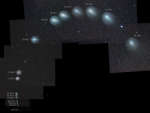 Three Month Composite of Comet Holmes
5.02.2008
How has Comet Holmes changed? Since brightening unexpectedly by nearly one million fold in late October, the last three months have found the coma of Comet 17P/Holmes both expanding and fading. This spectacular composite image shows how the coma and tail of Comet Holmes have changed.
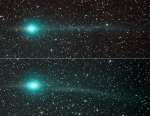 Comet Lulin Tails
7.02.2009
Sweeping through the inner solar system, Comet Lulin is easily visible in both northern and southern hemispheres with binoculars or a small telescope. Recent changes in Lulin's lovely greenish coma and tails are featured in this two panel comparison of images taken on January 31st (top) and February 4th.
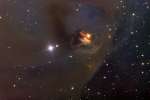 T Tauri and Hind s Variable Nebula
26.03.2011
The yellowish star near center in this remarkable telescopic skyview is T Tauri, prototype of the class of T Tauri variable stars. Nearby it is a dusty yellow cosmic cloud historically known as Hind's Variable Nebula (NGC 1555).
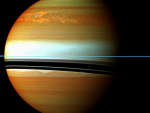 A Raging Storm System on Saturn
26.12.2011
It is one of the largest and longest lived storms ever recorded in our Solar System. First seen late last year, the above cloud formation in the northern hemisphere of Saturn started larger than the Earth and soon spread completely around the planet.
|
January February March April May June July August September October |
|||||||||||||||||||||||||||||||||||||||||||||||||