
|
You entered: ring
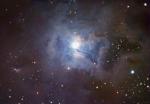 NGC 7023: The Iris Nebula
4.11.2004
Like delicate cosmic petals, these clouds of interstellar dust and gas have blossomed 1,300 light-years away in the fertile star fields of the constellation Cepheus. Sometimes called the Iris Nebula and dutifully cataloged as NGC 7023, this is not the only nebula in the sky to evoke the imagery of flowers.
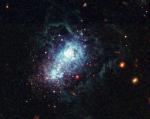 I Zwicky 18: Young Galaxy
3.12.2004
The Milky Way is an ordinary 12 billion year old spiral galaxy, and even our middle-aged Sun is pushing 4.5 billion years. But all the stars in dwarf galaxy I Zwicky 18 are much younger.
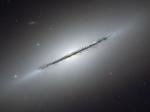 Edge On Galaxy NGC 5866
12.06.2006
Why is this galaxy so thin? Many disk galaxies are actually just as thin as NGC 5866, pictured above, but are not seen edge-on from our vantage point. One galaxy that is situated edge-on is our own Milky Way Galaxy.
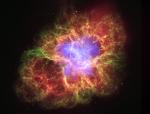 Composite Crab
26.10.2006
The Crab Nebula is cataloged as M1, the first object on Charles Messier's famous list of things which are not comets. In fact, the Crab is now known to be a supernova remnant, expanding debris from the death explosion of a massive star.
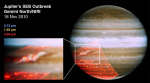 Dark Belt Reappearing on Jupiter
29.11.2010
Why are planet-circling clouds disappearing and reappearing on Jupiter? Although the ultimate cause remains unknown, planetary meteorologists are beginning to better understand what is happening. Earlier this year, unexpectedly, Jupiter's dark Southern Equatorial Belt (SEB) disappeared. The changes were first noted by amateurs dedicated to watching Jupiter full time.
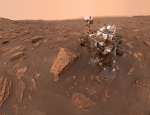 Curiosity s Dusty Self
23.06.2018
Winds on Mars can't actually blow spacecraft over. But in the low gravity, martian winds can loft fine dust particles in planet-wide storms, like the dust storm now raging on the Red Planet.
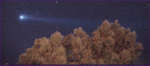 Comet Hyakutake and a Tree
10.04.1996
Comet Hyakutake is still visible as it continues its orbit around the Sun. The comet will brighten again in late April and early May. The above fascinating picture was taken with a three minute exposure. In the middle of the exposure, the photographer cleverly set off a flash, momentarily illuminating the foreground tree.
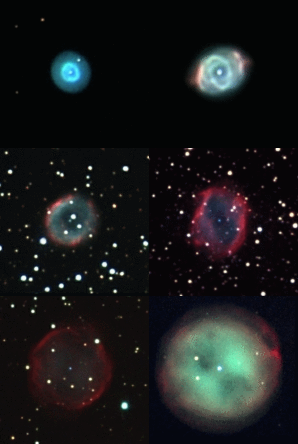 The Planetary Nebula Show
14.06.2003
What do the Owl, the Cat's Eye, the Ghost of Jupiter, and Saturn have in common? They're all planetary nebulae of course, glowing gaseous shrouds shed by dying sun-like stars as they run out of nuclear fuel.
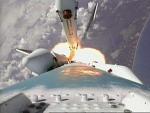 Launch of the Spirit Rover Toward Mars
28.07.2003
Next stop: Mars. Last month the first of two missions to Mars was launched from Cape Canaveral, Florida, USA above a Boeing Delta II rocket. Pictured above, solid fuel boosters are seen falling away as light from residual exhaust is reflected by the soaring rocket.
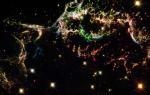 Recycling Cassiopeia A
30.08.2003
For billions of years, massive stars in our Milky Way Galaxy have lived spectacular lives. Collapsing from vast cosmic clouds, their nuclear furnaces ignite and create heavy elements in their cores. After a few million years, the enriched material is blasted back into interstellar space where star formation begins anew.
|
January February March April May June July August September October |
|||||||||||||||||||||||||||||||||||||||||||||||||